
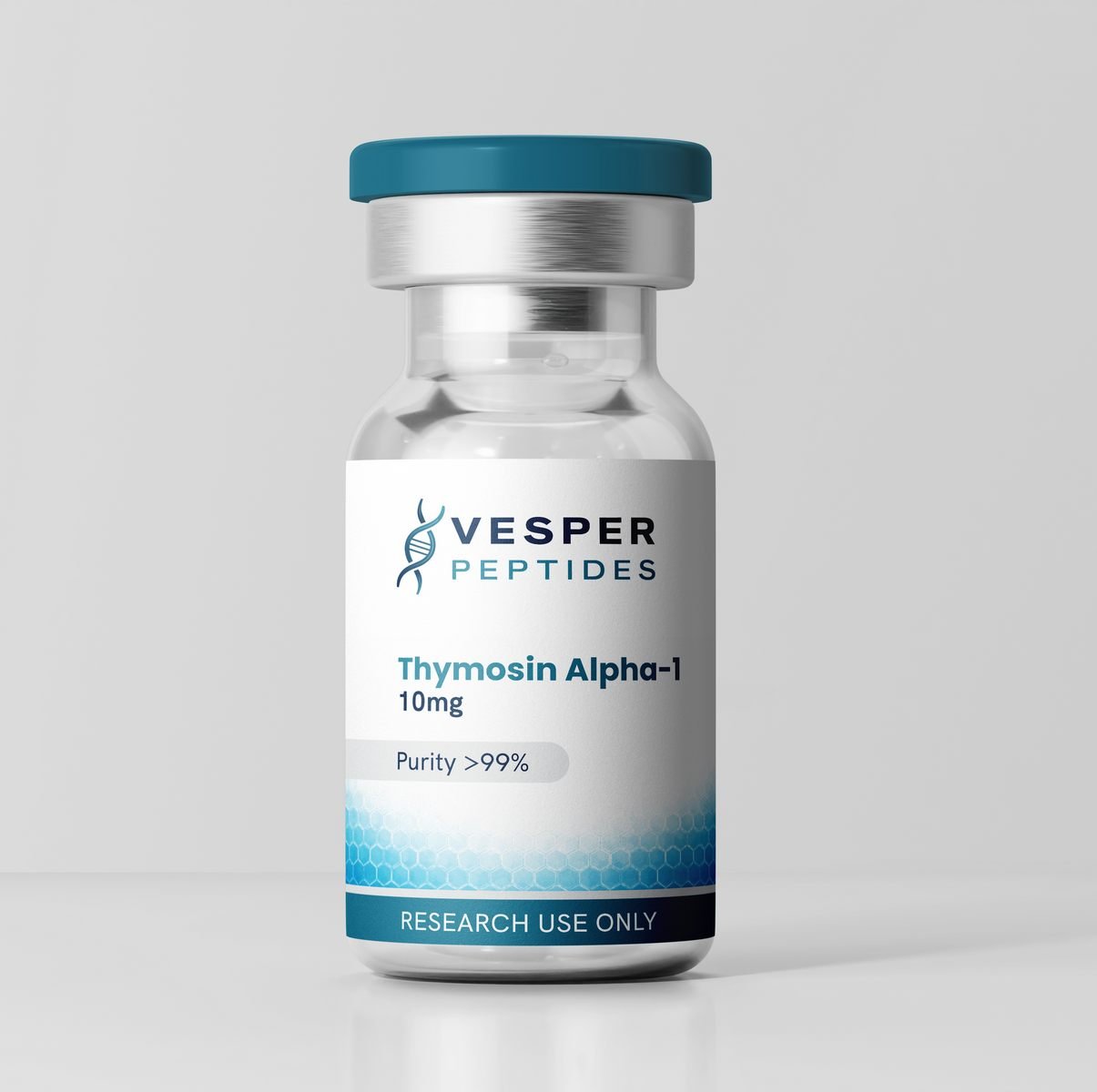
Thymosin Alpha-1 — Immunomodulatory Research Peptide
Thymosin Alpha-1 (Tα1 / Thymalfasin) is a synthetic 28-amino acid peptide identical in sequence to the N-terminal fragment of prothymosin alpha, originally isolated from bovine thymic tissue. It is one of the most extensively studied immunomodulatory peptides in the preclinical research literature. Researchers in immunology, cancer biology, infectious disease research, and autoimmune disease modeling use this Thymosin Alpha-1 research peptide to study innate and adaptive immune pathway activation, dendritic cell biology, and T-cell differentiation in experimental systems. Furthermore, its well-validated TLR-2 and TLR-9 receptor engagement profile makes it a highly specific and reproducible tool for studying pattern recognition receptor signaling in immune research contexts.
Mechanism of Action
Thymosin Alpha-1 exerts its immunomodulatory effects through engagement of multiple innate and adaptive immune signaling pathways.
TLR-2 and TLR-9 signaling — Tα1 activates Toll-like receptor 2 (TLR-2) and TLR-9 on dendritic cells and other antigen-presenting cells. TLR-2 engagement triggers NF-κB and MAPK signaling, promoting pro-inflammatory cytokine production and innate immune activation. TLR-9 engagement activates IRF-7-dependent type I interferon production. Consequently, Tα1 activates both NF-κB-driven and interferon-driven innate immune programs simultaneously.
Dendritic cell maturation — Tα1 actively promotes dendritic cell maturation, upregulating surface expression of MHC class II, CD80, CD86, and CD40 costimulatory molecules. As a result, it enhances antigen-presenting cell capacity and T-cell priming efficiency in immune research models.
NK cell activity — Tα1 enhances natural killer (NK) cell cytotoxic activity and interferon-gamma production. Furthermore, it promotes NK cell-mediated recognition and elimination of transformed or infected cells in cancer immunology and infectious disease research models.
T-lymphocyte differentiation — Tα1 drives naive T-cell differentiation toward Th1 effector phenotypes, promoting IFN-γ production and cytotoxic T-cell responses. Additionally, it supports regulatory T-cell function in contexts requiring immune tolerance modulation.
Key Research Applications
- TLR signaling research — Studies examining TLR-2 and TLR-9 activation kinetics, NF-κB and IRF-7 pathway engagement, and downstream cytokine production profiles using Tα1 as a defined TLR agonist research tool.
- Dendritic cell biology — Research examining Tα1-driven dendritic cell maturation, costimulatory molecule upregulation, and antigen presentation capacity in primary DC culture and bone marrow-derived DC systems.
- NK cell activity research — Studies investigating Tα1 effects on NK cell cytotoxicity, IFN-γ production, and tumor cell recognition in NK cell culture and co-culture model systems.
- Cancer immunology research — Preclinical tumor models examining Tα1-driven immune activation, cytotoxic T-cell priming, and NK cell-mediated anti-tumor responses in immunocompetent experimental systems.
- Infectious disease immunology — Studies examining Tα1-mediated innate immune activation, type I interferon induction, and adaptive immune priming in viral and bacterial infection preclinical models.
- Autoimmune and immune tolerance research — Investigation of Tα1 effects on regulatory T-cell activity, immune tolerance mechanisms, and Th1/Th2/Treg balance modulation in autoimmune disease models.
Peptide Profile
| Parameter | Detail |
|---|---|
| Common Name | Thymosin Alpha-1 |
| Also Known As | Tα1, Thymalfasin |
| Sequence Length | 28 amino acids |
| Receptor Targets | TLR-2, TLR-9 |
| Key Pathways | NF-κB, IRF-7/IFN, DC maturation, NK activation, Th1 differentiation |
| Molecular Weight | ~3,108 Da |
| Form | Lyophilized powder |
| Purity | ≥98% (HPLC verified) |
| Available Size | 10mg |
| Storage | −20°C (lyophilized); 4°C (reconstituted) |
| Reconstitution | Sterile bacteriostatic water |
Reconstitution & Storage
Reconstitute Thymosin Alpha-1 with sterile bacteriostatic water. Add solvent slowly along the inner vial wall and swirl gently until fully dissolved. Do not shake or vortex. Store lyophilized vials at −20°C, protected from light and moisture. Once reconstituted, maintain at 4°C and use within 28–30 days. Avoid repeated freeze-thaw cycles to preserve TLR binding activity and immunomodulatory potency.
For research use only. Not intended for human or veterinary administration. This product is not a drug, supplement, or food product.
Reviews
There are no reviews yet.