
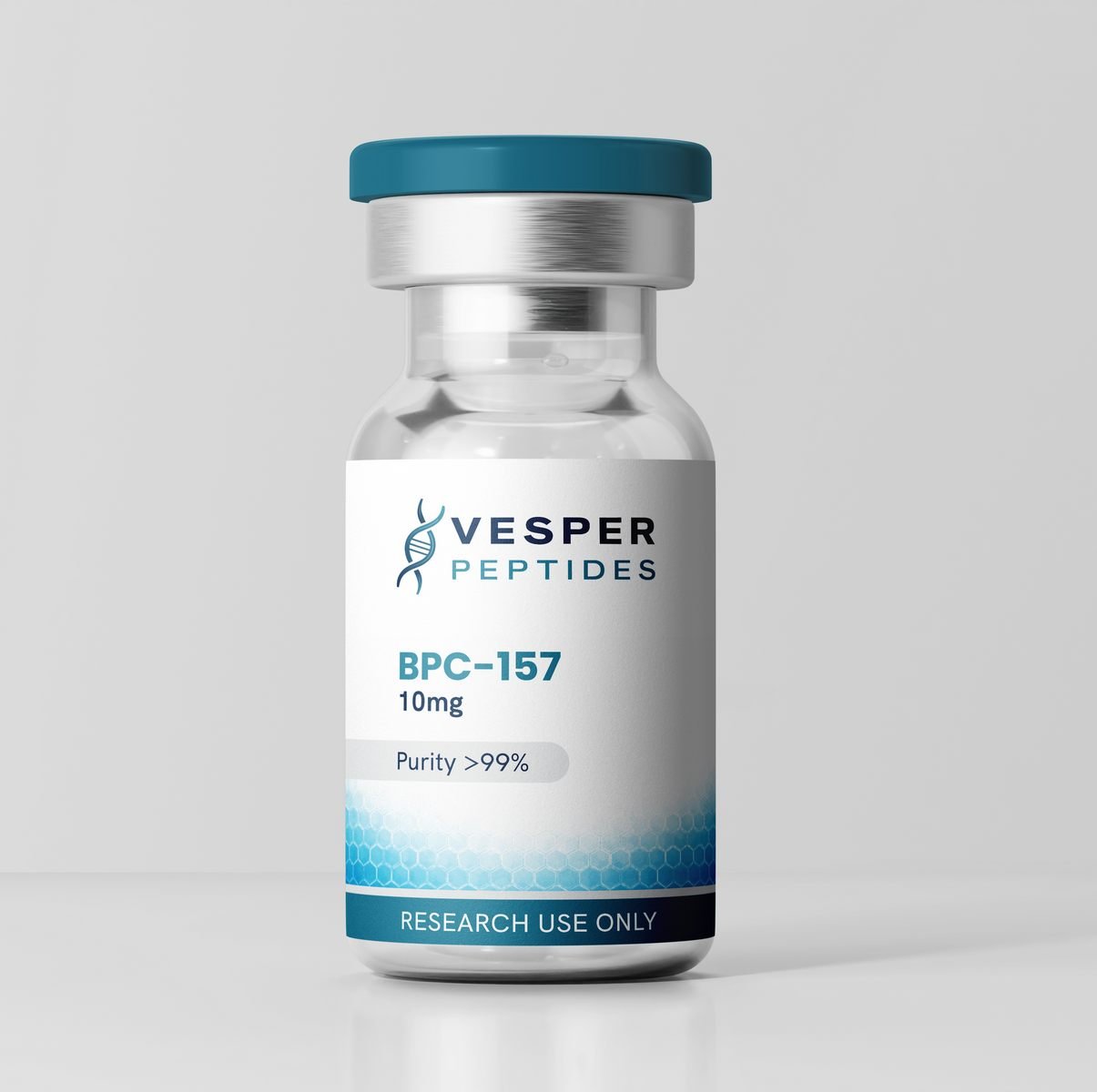
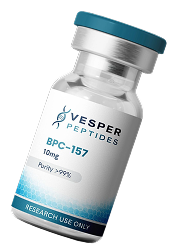
BPC-157 — Cytoprotective Pentadecapeptide Research Peptide
BPC-157 (Body Protection Compound 157) is a synthetic pentadecapeptide (Gly-Glu-Pro-Pro-Pro-Gly-Lys-Pro-Ala-Asp-Asp-Ala-Gly-Leu-Val) derived from a partial sequence of a cytoprotective protein isolated from gastric juice. Researchers in regenerative medicine, tissue repair biology, and gastrointestinal research use this BPC-157 research peptide as a primary tool compound for studying cytoprotective mechanisms, multi-tissue repair signaling, and angiogenesis regulation. Furthermore, its remarkably broad activity profile — spanning tendon, ligament, muscle, bone, gastrointestinal, and neurological tissue repair models — makes it one of the most extensively studied and versatile cytoprotective peptides in the preclinical research literature.
Mechanism of Action
BPC-157 engages multiple repair and cytoprotective signaling pathways simultaneously. This multi-pathway activity distinguishes it from single-mechanism repair compounds and accounts for its broad tissue applicability in preclinical research systems.
VEGF and angiogenesis signaling — BPC-157 actively upregulates vascular endothelial growth factor (VEGF) expression and its receptor VEGFR2 in injured tissue. Consequently, it promotes neovascularization and improved blood supply to repair sites — a critical early step in tissue healing that supports subsequent cellular repair processes.
Nitric oxide pathway modulation — BPC-157 engages the nitric oxide (NO) system, modulating eNOS activity and NO production in vascular endothelial cells. As a result, it supports vasodilation, blood flow regulation, and endothelial protection at injury sites.
FAK-paxillin pathway activation — BPC-157 activates focal adhesion kinase (FAK) and its downstream effector paxillin. This promotes cell migration, extracellular matrix remodeling, and fibroblast and tenocyte recruitment to injured tissue sites. Furthermore, FAK-paxillin signaling drives the structural reorganization of the cytoskeleton necessary for effective tissue repair.
Dopaminergic and serotonergic system modulation — BPC-157 additionally interacts with central and peripheral dopaminergic and serotonergic pathways, providing a mechanistic basis for its observed effects in models of gastrointestinal motility, stress response, and neurological tissue protection.
Key Research Applications
Researchers actively use BPC-157 across a wide range of tissue repair and cytoprotection research domains. Specifically, it supports:
- Tendon and ligament repair research — Studies examining BPC-157-driven tenocyte proliferation, collagen synthesis, extracellular matrix remodeling, and VEGF-mediated revascularization in tendon injury models and primary tenocyte culture systems.
- Skeletal muscle repair research — Investigation of BPC-157 effects on myoblast proliferation, muscle fiber repair, and satellite cell activity in muscle crush injury and laceration preclinical models.
- Gastrointestinal tissue repair — Studies examining cytoprotective and mucosal healing effects of BPC-157 in gastric ulcer, intestinal anastomosis, and inflammatory bowel disease preclinical models — consistent with its derivation from a gastric cytoprotective protein sequence.
- Bone and cartilage repair research — Preclinical models investigating BPC-157 effects on osteoblast activity, bone defect healing, and cartilage repair in bone fracture and joint injury models.
- Angiogenesis research — Studies examining VEGF upregulation kinetics, capillary density increases, and blood flow restoration in ischemic and injured tissue models using BPC-157 as a pro-angiogenic research tool.
- Neurological cytoprotection research — Investigation of BPC-157 neuroprotective effects in dopaminergic pathway models, peripheral nerve injury systems, and spinal cord injury preclinical research.
BPC-157 and the BPC + TB Blend
BPC-157 is also available in combination with TB-500 as the BPC + TB Blend — a dual-mechanism cytoprotective formulation combining BPC-157’s multi-pathway tissue repair activity with TB-500’s actin-sequestering, angiogenic, and AKT pathway-mediated repair mechanisms. Researchers who need to study synergistic dual-compound cytoprotective activity should consider the BPC + TB Blend for their experimental protocols.
Peptide Profile
| Parameter | Detail |
|---|---|
| Common Name | BPC-157 |
| Full Name | Body Protection Compound 157 |
| Sequence | Gly-Glu-Pro-Pro-Pro-Gly-Lys-Pro-Ala-Asp-Asp-Ala-Gly-Leu-Val |
| Sequence Length | 15 amino acids (pentadecapeptide) |
| Key Pathways | VEGF/VEGFR2, NO system, FAK-paxillin, dopaminergic |
| Molecular Weight | ~1,419 Da |
| Form | Lyophilized powder |
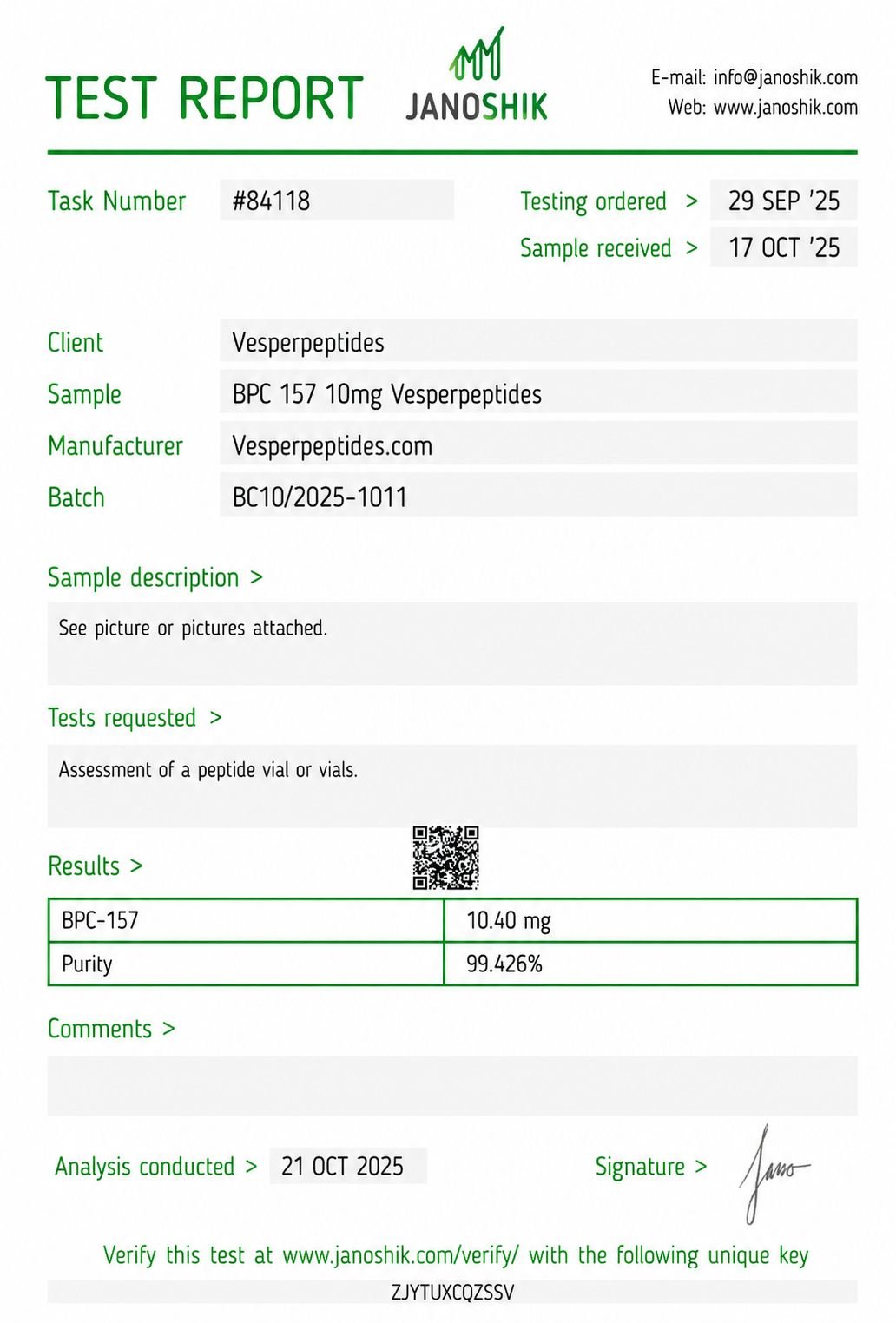
| Purity | ≥98% (HPLC verified) |
| Available Size | 10mg |
| Storage | −20°C (lyophilized); 4°C (reconstituted) |
| Reconstitution | Sterile bacteriostatic water |
| Solubility | Freely water-soluble |
Reconstitution Guidelines
Reconstitute BPC-157 with sterile bacteriostatic water. BPC-157 is freely water-soluble and dissolves readily without requiring acidic conditions. Add solvent slowly along the inner vial wall and gently swirl until fully dissolved. Do not shake or vortex. For a 10mg vial, researchers typically add 1–2ml of solvent to achieve a suitable working concentration. Furthermore, prepare single-use aliquots before storage at 4°C to minimize repeated freeze-thaw exposure across multi-session experimental protocols.
Storage Conditions
Store lyophilized BPC-157 vials at −20°C, protected from direct light and moisture. Keep vials sealed until the point of reconstitution. Furthermore, once reconstituted, maintain at 4°C and use within 28–30 days. BPC-157 is relatively stable in aqueous solution at neutral pH — however, avoid repeated freeze-thaw cycles to preserve full cytoprotective biological activity throughout the study duration.
For research use only. Not intended for human or veterinary administration. This product is not a drug, supplement, or food product.
Reviews
There are no reviews yet.