
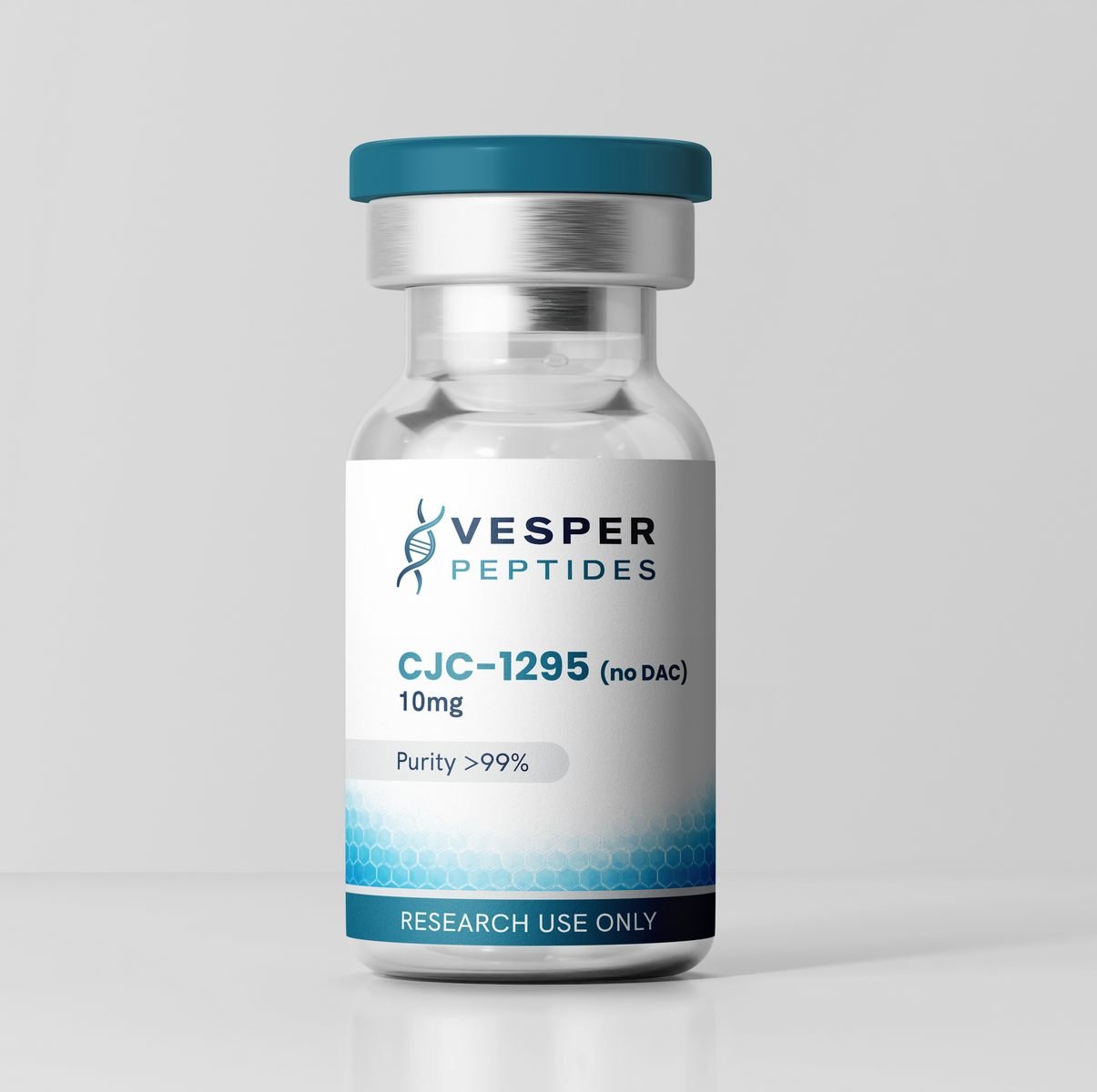
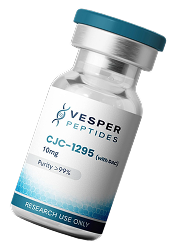
CJC-1295 (No DAC) — GHRH Analogue Research Peptide for Growth Hormone Research
CJC-1295 without DAC is a synthetic, tetrasubstituted analogue of growth hormone-releasing hormone (GHRH) engineered for enhanced resistance to enzymatic degradation while retaining a defined, short-to-intermediate pharmacokinetic profile. Researchers in endocrinology, pituitary biology, and somatotropic axis research use this CJC-1295 no DAC research peptide as a precise tool compound for studying GHRH receptor activation, GH secretion dynamics, and downstream IGF-1 axis signaling. Furthermore, its well-characterized stability improvements over native GHRH — without the prolonged albumin-binding half-life extension of the DAC version — make it uniquely valuable in experimental designs requiring defined GH stimulation windows.
Mechanism of Action
CJC-1295 (No DAC) binds the GHRH receptor (GHRHR) on anterior pituitary somatotroph cells with high affinity. Upon binding, it activates adenylyl cyclase through Gs-protein coupling, elevating intracellular cAMP and PKA activity. As a result, it stimulates both GH synthesis and GH secretion in a pulsatile, time-limited manner consistent with physiological GH release patterns.
Four key amino acid substitutions distinguish CJC-1295 from native GHRH(1–29). These substitutions protect it from dipeptidyl peptidase IV (DPP-IV) cleavage at position 2, reduce oxidation at Met27, and improve overall proteolytic stability. Consequently, CJC-1295 (No DAC) achieves a significantly extended active half-life compared to native GHRH while still clearing from circulation within a defined timeframe. Therefore, researchers use it in protocols where pulsatile GH stimulation — mimicking physiological GH release patterns — is experimentally preferable to the sustained, continuous GH elevation produced by CJC-1295 with DAC.
CJC-1295 No DAC vs. CJC-1295 With DAC — Choosing the Right Tool
Both CJC-1295 variants target GHRHR and stimulate GH release. However, they differ fundamentally in their pharmacokinetic profiles and therefore in their research applications.
CJC-1295 (No DAC) clears from the system within hours of administration, producing defined GH pulses that researchers can time precisely within their experimental protocols. This makes it the preferred tool compound for studies examining GH pulse amplitude, GH pulse frequency, and pituitary responsiveness to repeated GHRH stimulation. Additionally, it allows researchers to control the on/off timing of GH stimulation with greater precision than long-acting variants permit.
CJC-1295 with DAC, by contrast, binds albumin covalently and maintains GHRHR activation continuously over days. Researchers who need sustained GH elevation rather than defined pulses therefore choose the DAC version instead. Both products are available separately to support flexible experimental design across the full range of GH research protocols.
Key Research Applications
Researchers actively use CJC-1295 (No DAC) across multiple growth hormone and pituitary research domains. Specifically, it supports:
- GHRH receptor pharmacology — Characterization of GHRHR binding kinetics, cAMP signaling dynamics, and receptor desensitization profiles in primary pituitary cell cultures and heterologous expression systems.
- GH pulsatility research — Studies examining the amplitude, frequency, and duration of GH secretion pulses in response to defined GHRH receptor stimulation in ex vivo pituitary preparations and in vivo preclinical models.
- Pituitary somatotroph biology — Investigation of GH synthesis, storage, and regulated secretion mechanisms in somatotroph cell populations using CJC-1295 (No DAC) as a controlled stimulatory agent.
- IGF-1 axis research — Downstream studies examining GH-stimulated hepatic IGF-1 production, circulating IGF-1 levels, and IGF-1 receptor signaling in preclinical model systems.
- Comparative GHRH analogue research — Head-to-head experimental designs comparing CJC-1295 (No DAC) against native GHRH, Sermorelin, Tesamorelin, and CJC-1295 with DAC to characterize the contribution of half-life and stability modifications to GH secretory responses.
- Growth hormone secretagogue combination studies — Research protocols pairing CJC-1295 (No DAC) with GHRPs such as Ipamorelin or GHRP-6 to study synergistic GH release through simultaneous GHRHR and GHSR-1a co-activation.
Peptide Profile
| Parameter | Detail |
|---|---|
| Common Name | CJC-1295 (No DAC) |
| Also Known As | Modified GRF(1-29), Mod GRF 1-29 |
| Receptor Target | GHRH receptor (GHRHR) |
| Mechanism Class | GHRH analogue / GH secretagogue |
| Molecular Weight | ~3,367 Da |
| Form | Lyophilized powder |
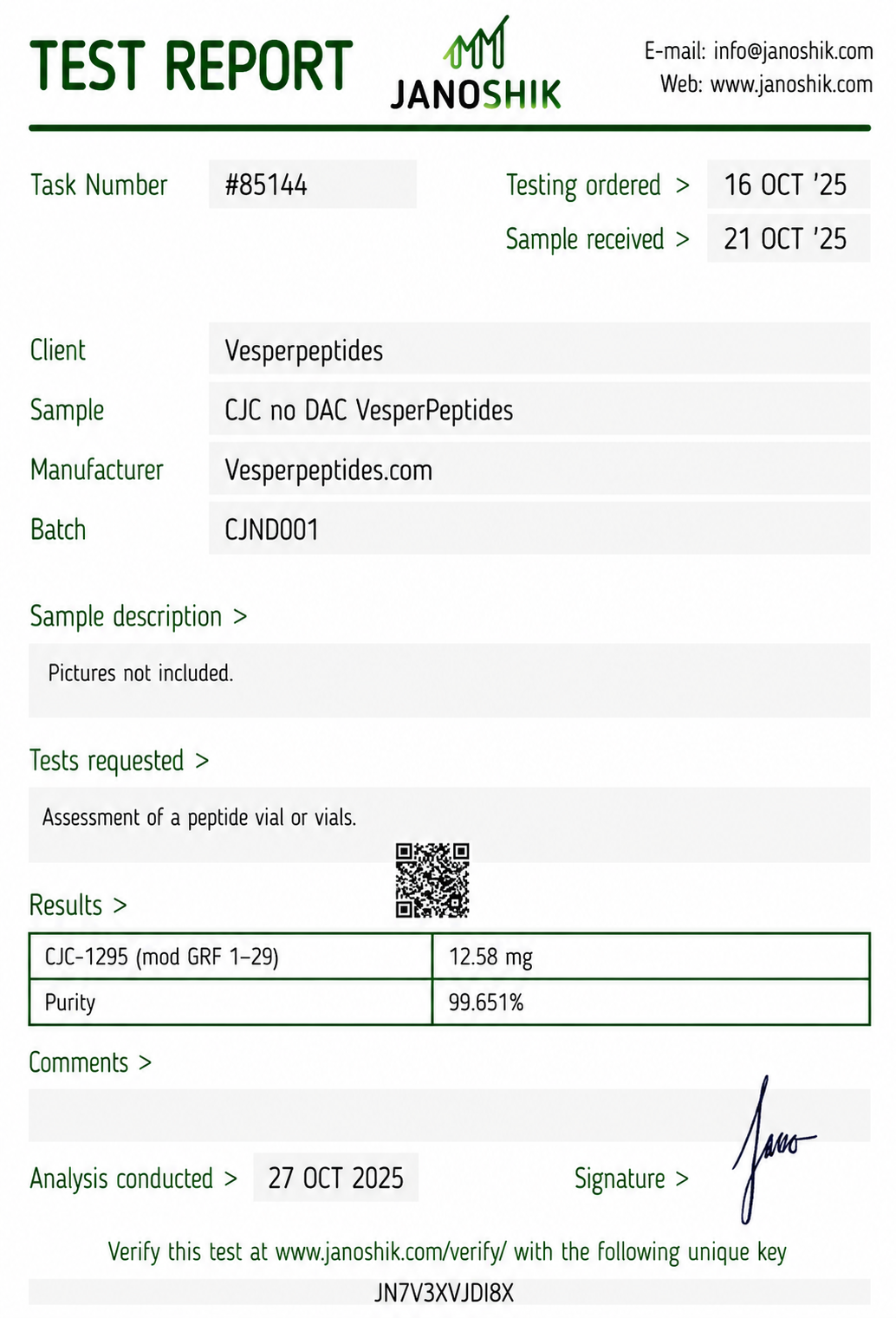
| Purity | ≥98% (HPLC verified) |
| Available Size | 10mg |
| Storage | −20°C (lyophilized); 4°C (reconstituted) |
| Reconstitution | Sterile bacteriostatic water |
Reconstitution Guidelines
Reconstitute CJC-1295 (No DAC) with sterile bacteriostatic water. Add solvent slowly along the inner vial wall and gently swirl until the lyophilized powder fully dissolves. Do not shake or vortex. For a 10mg vial, researchers typically add 1–2ml of solvent to achieve a suitable working concentration. Furthermore, prepare single-use aliquots before storage at 4°C to minimize repeated freeze-thaw exposure across multi-session experimental protocols.
Storage Conditions
Store lyophilized CJC-1295 (No DAC) vials at −20°C, protected from direct light and moisture. Furthermore, keep vials sealed until the point of reconstitution. Once reconstituted, maintain at 4°C and use within 28–30 days. Avoid repeated freeze-thaw cycles to preserve GHRHR binding affinity and peptide integrity throughout the study duration.
For research use only. Not intended for human or veterinary administration. This product is not a drug, supplement, or food product.
Reviews
There are no reviews yet.