
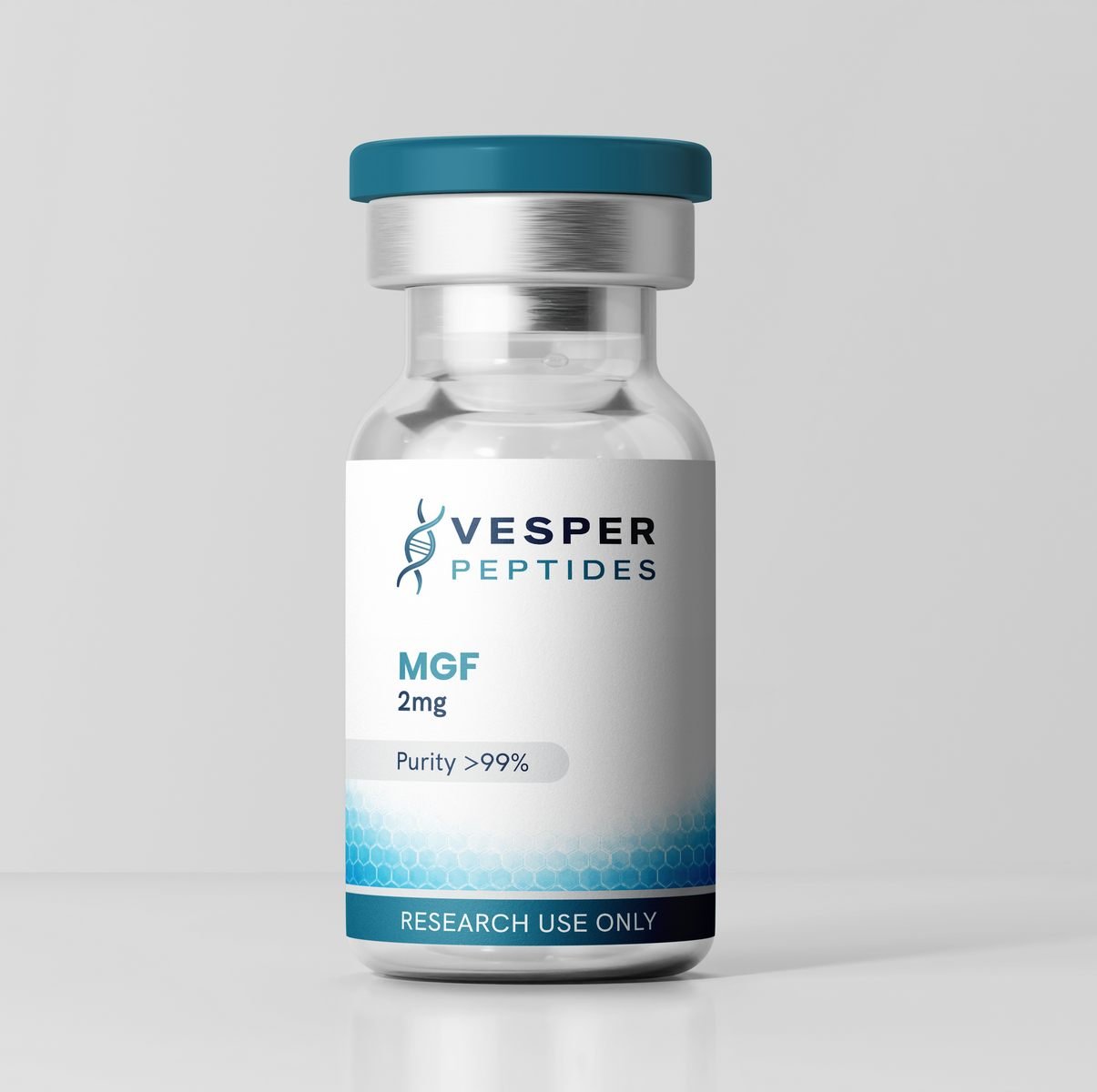
MGF — Mechano Growth Factor IGF-1 Splice Variant Research Peptide
MGF (Mechano Growth Factor) is a research-grade synthetic peptide corresponding to the unique C-terminal E-domain of the mechano growth factor splice variant of the insulin-like growth factor 1 (IGF-1) gene. The IGF-1 gene undergoes alternative splicing in response to mechanical stimulation, exercise, and tissue injury to produce several distinct isoforms. MGF is the locally expressed, tissue-specific isoform — as opposed to the liver-derived systemic IGF-1 isoform that circulates in plasma. Researchers in muscle biology, tissue repair science, and regenerative medicine research use this MGF mechano growth factor research peptide to study local satellite cell activation, autocrine and paracrine tissue repair signaling, and the mechanobiology of muscle and connective tissue repair. Furthermore, its distinct mechanism and expression pattern — entirely separate from systemic IGF-1 — make it a uniquely valuable tool for dissecting local from systemic IGF-1 gene biology.
Mechanism of Action
MGF exerts its biological effects through a mechanism that differs fundamentally from systemic IGF-1. The unique 24-amino acid E-domain peptide of MGF does not bind the IGF-1 receptor with the same affinity as mature IGF-1. Instead, it activates a separate receptor-mediated pathway that drives satellite cell activation and proliferation directly.
In mechanically loaded or injured muscle tissue, MGF expression increases rapidly and locally. It then acts in an autocrine and paracrine manner on muscle satellite cells — the resident stem cell population responsible for muscle repair and regeneration. MGF drives satellite cells out of quiescence and into active proliferation. As a result, it rapidly expands the myoblast pool available for muscle fiber repair and regeneration following injury. Consequently, researchers use MGF as a primary tool compound for studying the early stages of muscle repair — specifically the satellite cell activation and proliferation phase that precedes myoblast differentiation and myotube fusion.
Furthermore, MGF’s localized expression and rapid degradation under physiological conditions mean that its effects are spatially and temporally confined to the site of mechanical stimulation or injury. This makes it mechanistically distinct from systemic IGF-1 LR3, which acts broadly across all IGF-1R-expressing tissues. Therefore, researchers specifically choose MGF when studying local, tissue-level repair mechanisms rather than systemic anabolic signaling.
MGF vs. IGF-1 LR3 — Understanding the Distinction
Both MGF and IGF-1 LR3 derive from the IGF-1 gene. However, they represent fundamentally different biological entities serving distinct research purposes.
IGF-1 LR3 is a long-acting systemic IGF-1 analogue. It engages IGF-1R broadly across all responsive tissues, activates PI3K/AKT/mTOR and RAS/MAPK/ERK signaling cascades, and drives anabolic responses across multiple cell types simultaneously. Researchers use it in studies requiring sustained, broad-spectrum IGF-1R activation.
MGF, by contrast, represents the local, mechanically-responsive arm of IGF-1 gene biology. It activates satellite cells through a partially distinct receptor pathway, drives local myoblast proliferation, and operates within a defined spatial and temporal window at the tissue injury or mechanical loading site. Researchers who study local muscle repair mechanisms, satellite cell biology, or mechanobiology specifically require MGF — IGF-1 LR3 cannot replicate its locally acting, satellite cell-activating biology.
Key Research Applications
Researchers actively use MGF mechano growth factor research peptide across multiple muscle biology and tissue repair domains. Specifically, it supports:
- Satellite cell activation research — Studies investigating MGF-driven quiescence exit, satellite cell proliferation kinetics, and myogenic progenitor pool expansion in primary satellite cell cultures and ex vivo muscle preparations.
- Local muscle repair research — Preclinical models examining the autocrine and paracrine roles of MGF in initiating the muscle repair response following mechanical injury, eccentric loading, or ischemic damage.
- Mechanobiology research — Studies investigating how mechanical stimulation of muscle and connective tissue triggers local IGF-1 gene splicing toward the MGF isoform and the downstream cellular consequences of this splice variant expression.
- Myoblast proliferation studies — Investigation of MGF-stimulated myoblast cell cycle re-entry, proliferation rate, and the transition from MGF-driven proliferation to IGF-1-driven differentiation and myotube fusion.
- Tissue regeneration research — Broader regenerative biology studies using MGF as a local tissue repair signal in non-muscle connective tissue models including tendon, cartilage, and cardiac tissue repair systems.
- Comparative IGF-1 isoform research — Experimental designs directly comparing MGF against systemic IGF-1 LR3 to characterize the distinct biological contributions of local versus systemic IGF-1 gene products to tissue repair and anabolic signaling.
Peptide Profile
| Parameter | Detail |
|---|---|
| Common Name | MGF |
| Full Name | Mechano Growth Factor |
| Origin | C-terminal E-domain of IGF-1 MGF splice variant |
| Primary Action | Satellite cell activation, local autocrine repair |
| Expression Trigger | Mechanical stimulation, tissue injury |
| Molecular Weight | ~2,867 Da |
| Form | Lyophilized powder |
| Purity | ≥98% (HPLC verified) |
| Available Size | 2mg |
| Storage | −20°C (lyophilized); 4°C (reconstituted) |
| Reconstitution | Sterile bacteriostatic water |
Reconstitution Guidelines
Reconstitute MGF with sterile bacteriostatic water. Add solvent slowly along the inner vial wall and gently swirl until the lyophilized powder fully dissolves. Do not shake or vortex. For a 2mg vial, researchers typically add 0.5–1ml of solvent to achieve a suitable working concentration for satellite cell and myoblast assay systems. Furthermore, prepare single-use aliquots before storage at 4°C to minimize repeated freeze-thaw exposure, as MGF is susceptible to degradation with repeated temperature cycling.
Storage Conditions
Store lyophilized MGF vials at −20°C, protected from direct light and moisture. Keep vials sealed until the point of reconstitution. Furthermore, once reconstituted, maintain at 4°C and use within 14–21 days. Avoid repeated freeze-thaw cycles to preserve satellite cell-activating biological activity throughout the experimental program.
For research use only. Not intended for human or veterinary administration. This product is not a drug, supplement, or food product.









Reviews
There are no reviews yet.