
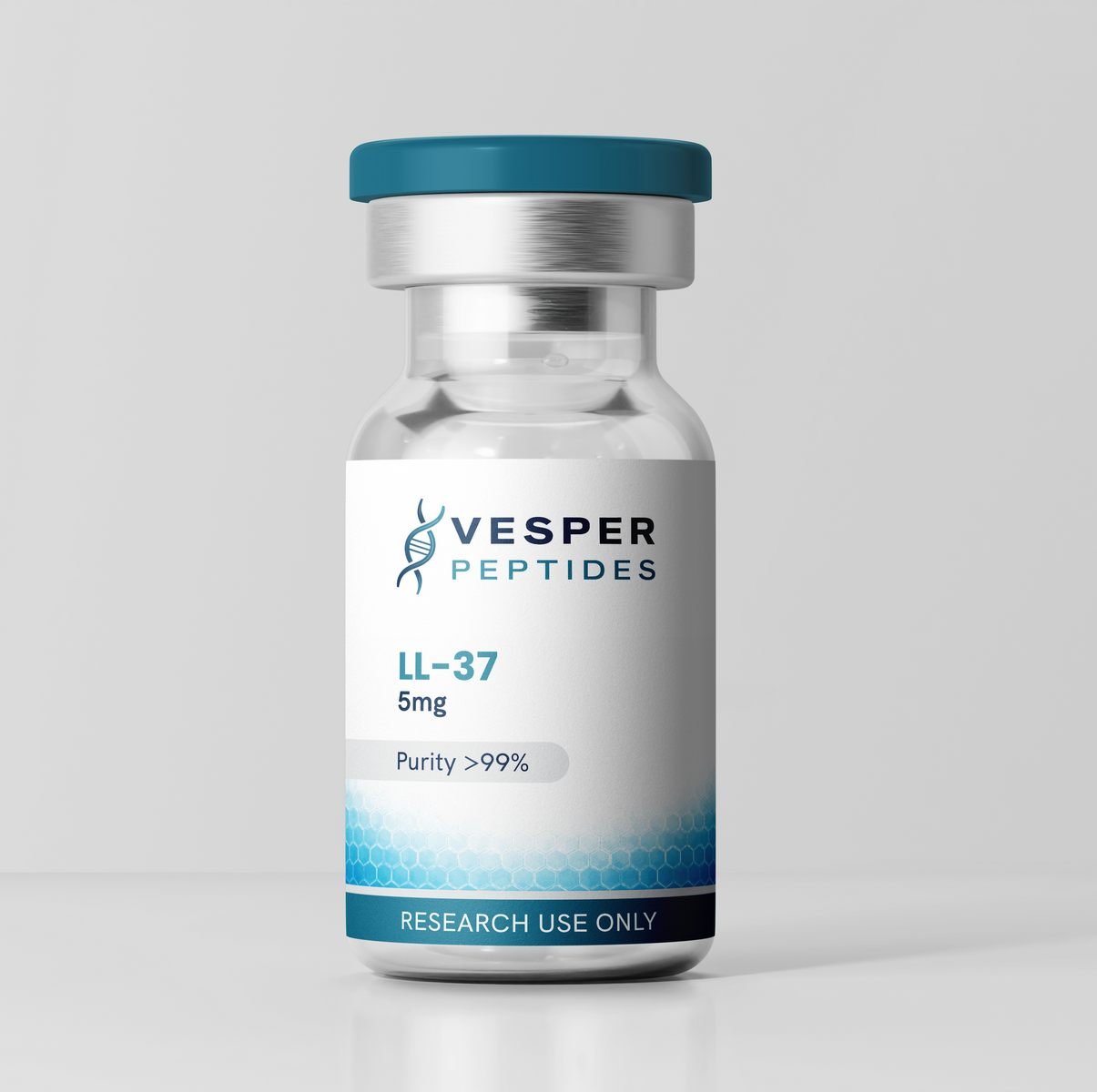
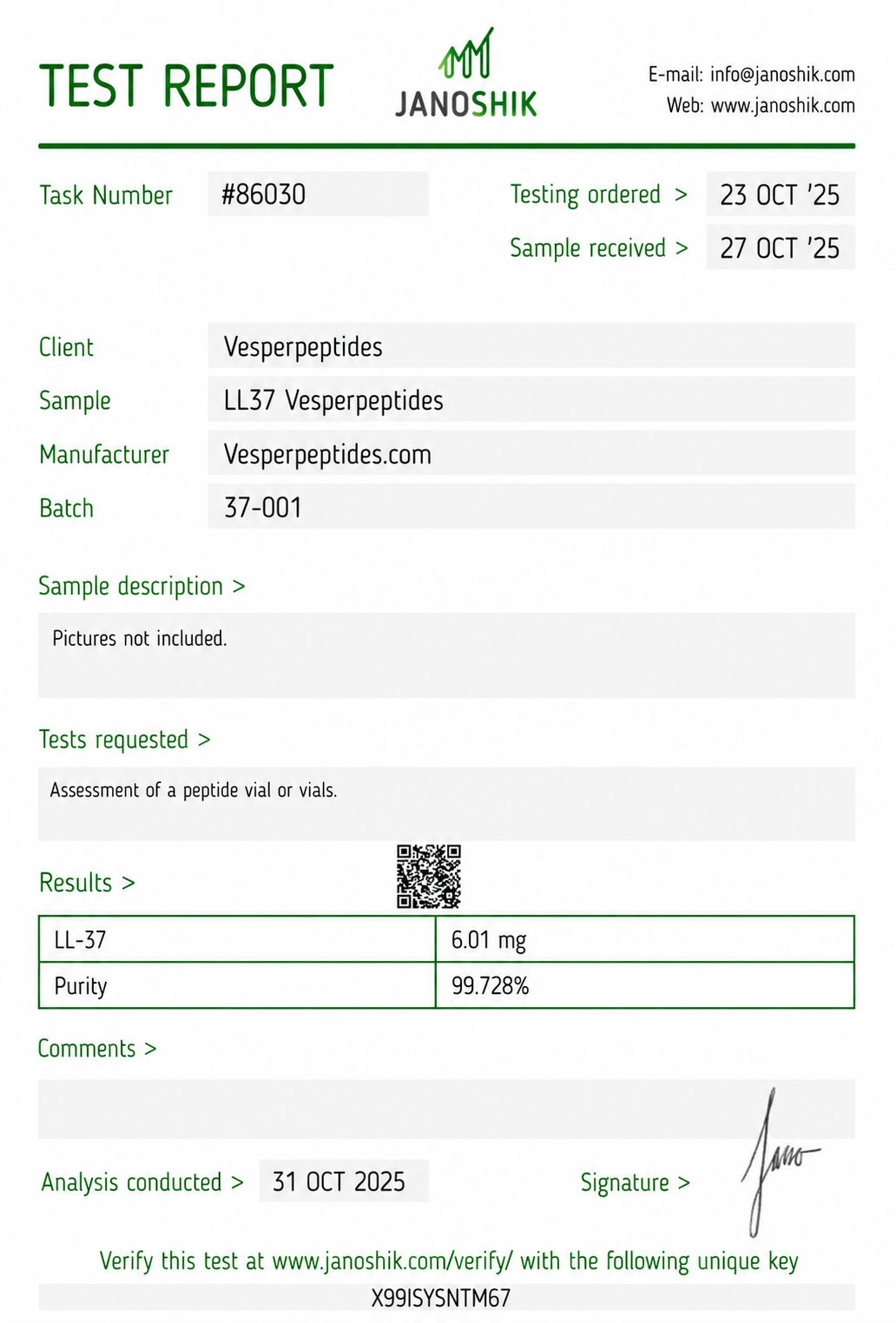
LL-37 — Human Cathelicidin Antimicrobial & Immunomodulatory Research Peptide
LL-37 is a synthetic 37-amino acid cationic amphipathic peptide corresponding to the C-terminal domain of hCAP18 — the only human cathelicidin precursor protein. It adopts an alpha-helical conformation in hydrophobic environments, enabling direct membrane disruption of microbial targets. Researchers in antimicrobial biology, innate immunity, and wound healing science use this LL-37 research peptide to study broad-spectrum host defence mechanisms, innate immune receptor modulation, and wound healing signaling in diverse experimental systems. Furthermore, LL-37’s multifunctional biology — spanning direct antimicrobial activity, TLR signaling modulation, angiogenesis stimulation, and keratinocyte activation — makes it one of the most mechanistically rich host defence research compounds available.
Mechanism of Action
Antimicrobial activity — LL-37 disrupts microbial membranes through electrostatic interaction with negatively charged bacterial phospholipids, followed by alpha-helical insertion and membrane destabilization. This mechanism produces broad-spectrum activity against gram-positive bacteria, gram-negative bacteria, enveloped viruses, and fungi. Consequently, researchers use it as a reference antimicrobial peptide in host defence and membrane disruption mechanism studies.
TLR4 antagonism — LL-37 binds and neutralizes lipopolysaccharide (LPS), preventing TLR4 engagement and downstream NF-κB activation. As a result, it attenuates LPS-driven pro-inflammatory responses in macrophage and monocyte systems. Therefore, researchers studying endotoxin-driven inflammation use LL-37 as a TLR4 signaling modulator.
FPRL-1 agonism — LL-37 activates formyl peptide receptor-like 1 (FPRL-1) on immune cells, driving chemotaxis, phagocyte recruitment, and pro-resolving inflammatory signaling. Additionally, FPRL-1 activation contributes to LL-37’s wound healing effects through neutrophil and monocyte recruitment to injury sites.
Wound healing and angiogenesis — LL-37 actively promotes keratinocyte migration, proliferation, and re-epithelialization in wound healing models. Furthermore, it stimulates endothelial cell tube formation and angiogenesis. Consequently, researchers include it in wound healing research panels alongside BPC-157 and GHK-Cu.
Key Research Applications
- Antimicrobial mechanism research — Studies characterizing LL-37 membrane disruption kinetics, minimum inhibitory concentrations, and spectrum of activity against diverse microbial targets.
- TLR signaling research — Investigation of LL-37-mediated TLR4 antagonism, LPS neutralization, and NF-κB suppression in macrophage and dendritic cell systems.
- Innate immune research — Studies examining FPRL-1-mediated chemotaxis, phagocyte recruitment, and pro-resolving immune signaling using LL-37 as an FPRL-1 agonist tool.
- Wound healing research — Investigation of LL-37 effects on keratinocyte migration, re-epithelialization, and angiogenesis in wound closure model systems.
- Host defence peptide biology — Studies examining the structure-activity relationships of cathelicidin peptides using LL-37 as the human reference compound.
Peptide Profile
| Parameter | Detail |
|---|---|
| Common Name | LL-37 |
| Full Name | Human cathelicidin C-terminal domain |
| Precursor | hCAP18 |
| Structure | Amphipathic alpha-helix (in hydrophobic environments) |
| Key Mechanisms | Membrane disruption, TLR4 antagonism, FPRL-1 agonism, angiogenesis |
| Molecular Weight | ~4,493 Da |
| Form | Lyophilized powder |
| Purity | ≥98% (HPLC verified) |
| Available Size | 5mg |
| Storage | −20°C (lyophilized); 4°C (reconstituted) |
| Reconstitution | Sterile water or PBS |
Reconstitution & Storage
Reconstitute with sterile water or PBS. LL-37 dissolves readily in aqueous solution. Add solvent slowly along the vial wall and swirl gently. Avoid vigorous agitation to prevent foam formation. Store lyophilized vials at −20°C, protected from light. Once reconstituted, maintain at 4°C and use within 14–21 days. Avoid repeated freeze-thaw cycles.
For research use only. Not intended for human or veterinary administration.
Reviews
There are no reviews yet.