
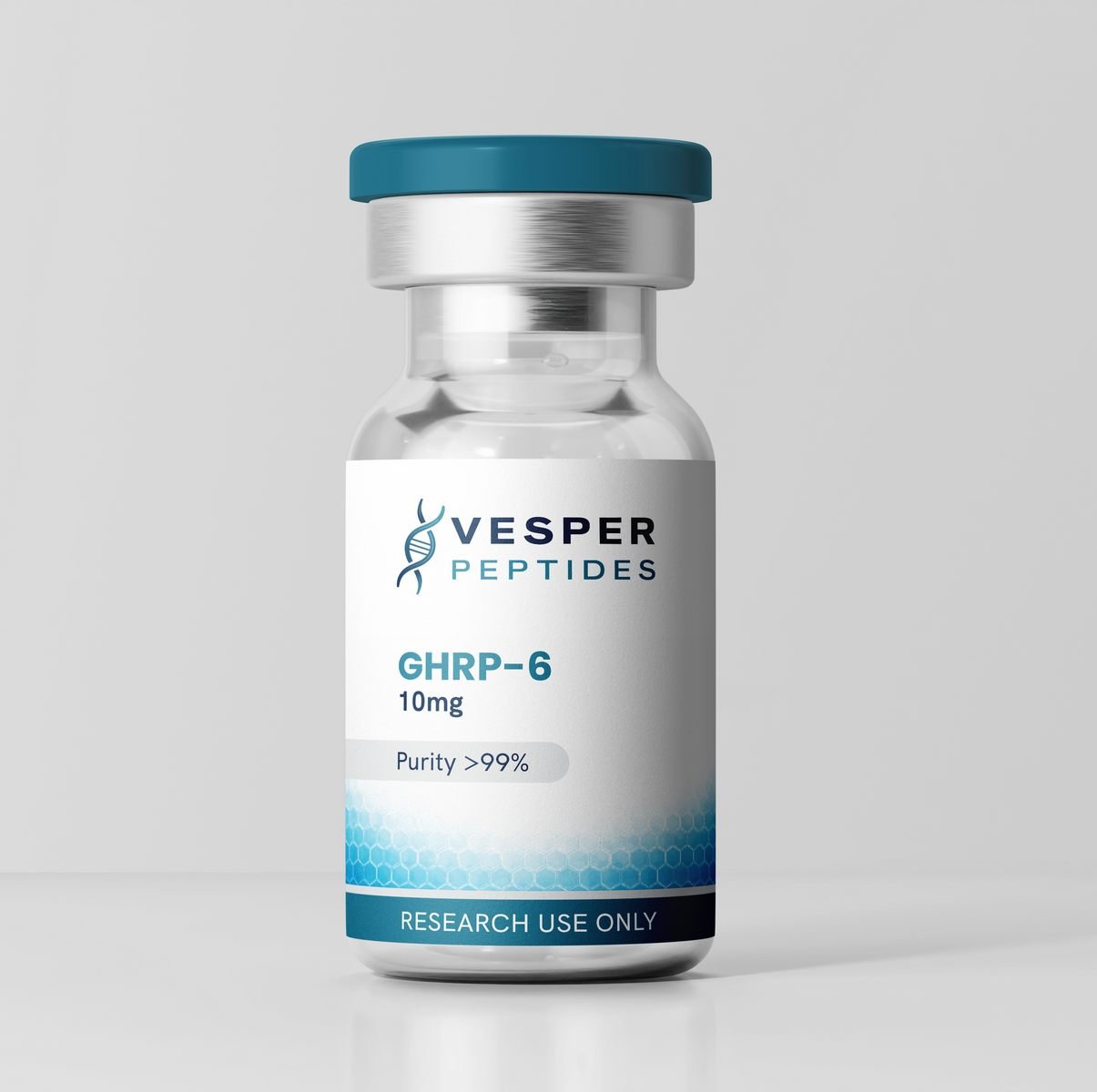
GHRP-6 — First-Generation GHSR-1a Agonist Research Peptide
GHRP-6 (Growth Hormone Releasing Peptide-6) is a synthetic hexapeptide (His-D-Trp-Ala-Trp-D-Phe-Lys-NH₂) and one of the first-generation GH secretagogues developed as a pharmacological tool for studying the ghrelin receptor (GHSR-1a) pathway. Researchers in pituitary biology, neuroendocrinology, and GH axis pharmacology use this GHRP-6 research peptide as a reference GHSR-1a agonist for studying GH secretagogue receptor pharmacology, pulsatile GH release mechanisms, and appetite-related signaling. Furthermore, its dual activity at both pituitary GHSR-1a and hypothalamic appetite circuits makes it one of the most broadly applicable first-generation GHRP tool compounds available — particularly in studies examining the crosstalk between GH secretion and energy homeostasis regulation.
Mechanism of Action
GHRP-6 binds the growth hormone secretagogue receptor type 1a (GHSR-1a) — the endogenous receptor for ghrelin — with high affinity. Upon binding, it activates Gq-protein coupled phospholipase C signaling, generating IP3 and DAG second messengers that elevate intracellular calcium and activate PKC. As a result, it potently stimulates GH secretion from anterior pituitary somatotroph cells through a mechanism that is entirely independent of GHRH receptor activation.
Importantly, GHSR-1a activation by GHRP-6 is synergistic with GHRHR stimulation. Consequently, combining GHRP-6 with a GHRH analogue such as CJC-1295 produces GH pulse amplitudes significantly greater than either compound achieves alone. This synergism occurs because the two receptor systems converge on common intracellular GH secretory machinery through independent upstream pathways. Therefore, researchers use GHRP-6 both as a standalone GHSR-1a research tool and as a GHRHR synergy partner in dual-secretagogue experimental designs.
Additionally, GHSR-1a activation in the hypothalamic arcuate nucleus stimulates appetite and orexigenic signaling through neuropeptide Y (NPY) and agouti-related peptide (AgRP) neurons. As a result, GHRP-6 concurrently activates both pituitary GH release and central appetite circuits — a dual activity profile that distinguishes it from more selective GHRPs such as Ipamorelin and makes it particularly valuable in research examining GH/appetite pathway crosstalk.
GHRP-6 vs. Second-Generation GHRPs
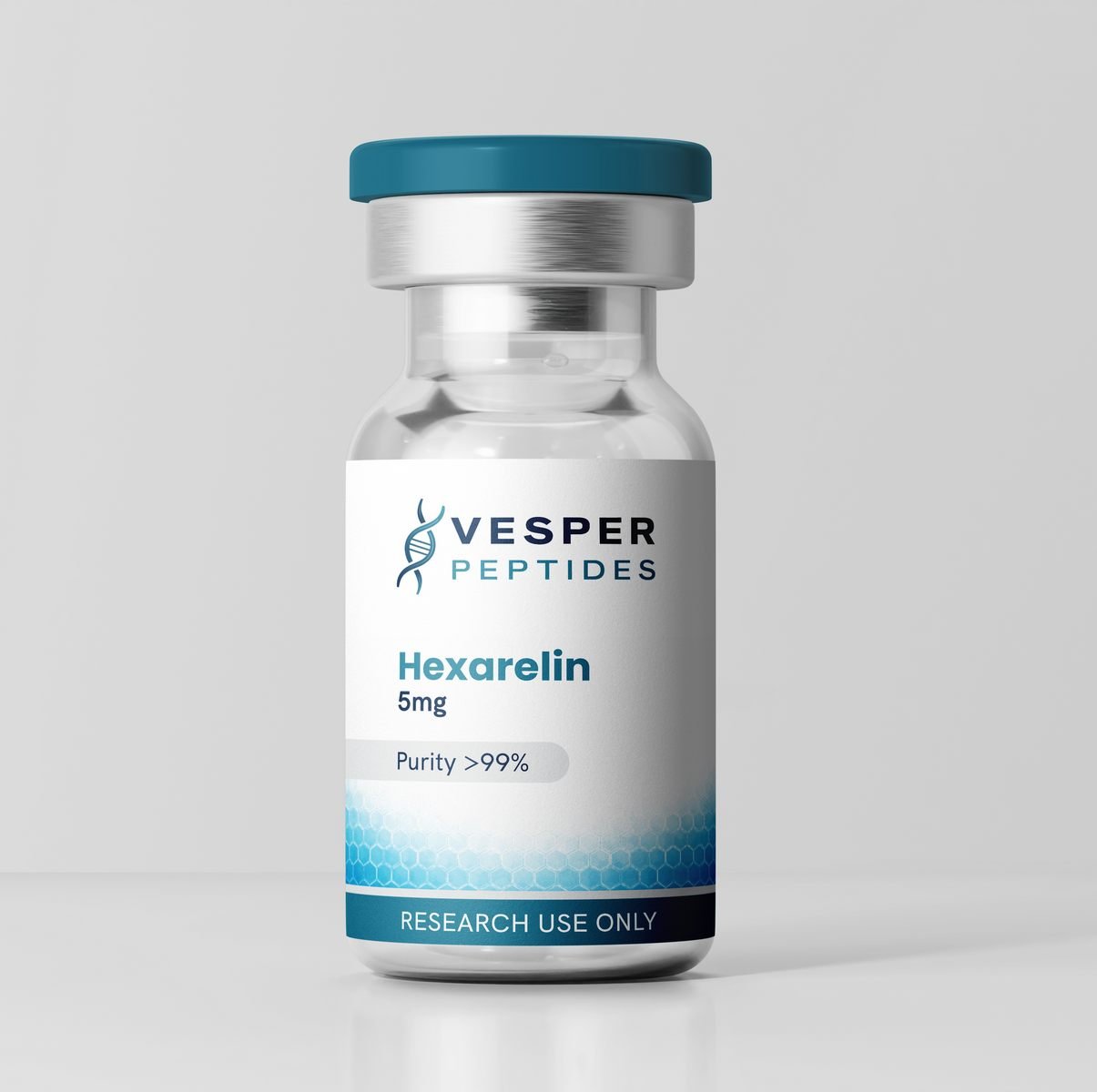
GHRP-6 represents the first generation of synthetic GHSR-1a agonists and differs from second-generation GHRPs in several important ways. Second-generation compounds such as Hexarelin achieve higher GH-releasing potency at the pituitary level. Additionally, selective GHRPs such as Ipamorelin minimize off-target effects on cortisol, ACTH, and prolactin secretion.
GHRP-6, however, occupies an important research niche precisely because of its broader activity profile. Its concurrent stimulation of GH secretion and appetite signaling makes it irreplaceable in studies specifically examining the GH/ghrelin/appetite axis. Furthermore, its extensive historical validation in the research literature provides researchers with a rich comparative dataset against which newer GHSR-1a agonists can be benchmarked. Consequently, it remains a gold-standard reference compound in GHSR-1a pharmacology research.
Key Research Applications
Researchers actively use GHRP-6 across multiple GH and appetite research domains. Specifically, it supports:
- GHSR-1a receptor pharmacology — Characterization of ghrelin receptor binding kinetics, Gq-protein signaling, IP3/DAG second messenger generation, and intracellular calcium mobilization in GHSR-1a-expressing cell systems.
- GH secretagogue research — Studies examining GHSR-1a-mediated GH pulse amplitude, secretion kinetics, and pituitary somatotroph response using GHRP-6 as a reference first-generation agonist.
- Appetite and orexigenic signaling research — Investigation of GHSR-1a-mediated NPY/AgRP neuron activation, orexigenic peptide expression, and food intake regulation in hypothalamic cell culture and preclinical model systems.
- GH/ghrelin axis crosstalk research — Studies examining the intersection of GH secretagogue signaling and ghrelin-mediated appetite regulation — a research area uniquely accessible through GHRP-6’s dual activity profile.
- Synergistic dual-secretagogue research — Experimental protocols combining GHRP-6 with GHRH analogues such as Sermorelin or CJC-1295 to study synergistic GH release through simultaneous GHSR-1a and GHRHR co-activation.
- Comparative GHRP research — Benchmarking studies comparing GHRP-6 against second-generation GHRPs (Hexarelin) and selective GHRPs (Ipamorelin) to characterize how receptor selectivity and structural modifications affect GH secretory potency and off-target hormonal effects.
Peptide Profile
| Parameter | Detail |
|---|---|
| Common Name | GHRP-6 |
| Full Name | Growth Hormone Releasing Peptide-6 |
| Sequence | His-D-Trp-Ala-Trp-D-Phe-Lys-NH₂ |
| Receptor Target | GHSR-1a (ghrelin receptor) |
| Generation | First-generation GHRP |
| Mechanism Class | GHSR-1a agonist / GH secretagogue |
| Molecular Weight | ~873 Da |
| Form | Lyophilized powder |
| Purity | ≥98% (HPLC verified) |
| Available Size | 10mg |
| Storage | −20°C (lyophilized); 4°C (reconstituted) |
| Reconstitution | Sterile bacteriostatic water |
Reconstitution Guidelines
Reconstitute GHRP-6 with sterile bacteriostatic water. Add solvent slowly along the inner vial wall and gently swirl until the lyophilized powder fully dissolves. Do not shake or vortex. For a 10mg vial, researchers typically add 1–2ml of solvent to achieve a suitable working concentration for their assay system. Additionally, prepare single-use aliquots before storage at 4°C to minimize repeated freeze-thaw exposure across multi-session experimental protocols.
Storage Conditions
Store lyophilized GHRP-6 vials at −20°C, protected from direct light and moisture. Furthermore, keep vials sealed until the point of reconstitution. Once reconstituted, maintain at 4°C and use within 28–30 days. Avoid repeated freeze-thaw cycles to preserve GHSR-1a binding affinity and peptide integrity throughout the study duration.
For research use only. Not intended for human or veterinary administration. This product is not a drug, supplement, or food product.
Reviews
There are no reviews yet.