
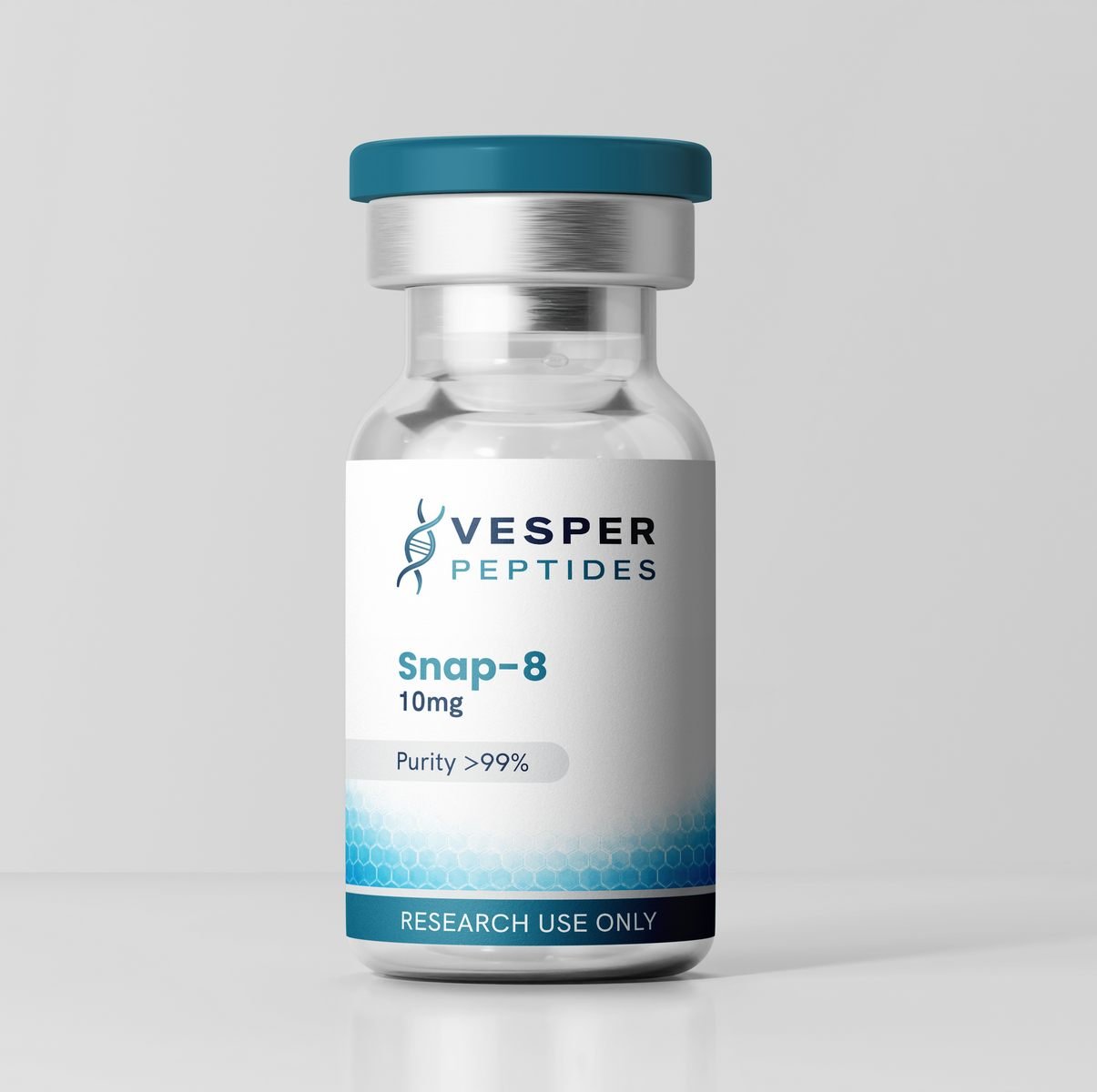
Snap-8 — SNAP-25 Inhibitor Research Peptide for SNARE Complex Research
Snap-8 (Acetyl Glutamyl Heptapeptide-3; Ac-EEMQRRA-NH₂) is a synthetic acetylated octapeptide that corresponds to a region of the SNAP-25 protein — a core component of the SNARE complex responsible for regulated vesicle exocytosis. Researchers in neuroscience, cell biology, and skin biology use this Snap-8 research peptide to study SNARE complex assembly mechanisms, neurotransmitter vesicle release, and neuromuscular junction signaling through competitive SNAP-25 inhibition. Furthermore, its defined SNARE-targeting mechanism and clean competitive inhibitor profile make it one of the most mechanistically specific tools available for studying regulated secretion machinery.
Mechanism of Action
The SNARE complex — comprising synaptobrevin/VAMP on vesicle membranes, and SNAP-25 and syntaxin on target membranes — drives membrane fusion and neurotransmitter vesicle exocytosis at the neuromuscular junction and neuronal synapses. SNAP-25 contributes two alpha-helical SNARE motifs to the four-helix SNARE bundle, and its assembly is essential for vesicle-membrane fusion.
Snap-8 competes with SNAP-25 for SNARE complex formation by mimicking the SNAP-25 binding region. By displacing SNAP-25 from the assembling SNARE complex, it reduces the efficiency of SNARE complex formation and consequently attenuates vesicle exocytosis. As a result, researchers use it to study how partial SNARE complex inhibition modulates neurotransmitter release kinetics, vesicle pool dynamics, and neuromuscular junction signal transmission. Furthermore, Snap-8 provides a less extreme SNARE inhibition model than complete botulinum toxin-mediated SNAP-25 cleavage — enabling researchers to study graded, dose-dependent effects on vesicle exocytosis.
Key Research Applications
- SNARE complex research — Studies examining SNAP-25 competitive binding, SNARE bundle assembly kinetics, and the structural requirements for productive vesicle-membrane fusion in biochemical and cell-based assay systems.
- Neurotransmitter release research — Investigation of Snap-8 effects on acetylcholine vesicle release, release probability, and quantal content at neuromuscular junction models.
- Neuromuscular junction signaling — Studies examining SNARE-dependent neuromuscular transmission efficiency and how graded SNARE inhibition affects muscle contraction signaling.
- Vesicle exocytosis mechanism research — Investigation of regulated secretory pathway dynamics, vesicle pool replenishment, and exocytosis kinetics under graded SNARE complex inhibition by Snap-8.
- Skin biology and cosmetic peptide research — Studies investigating Snap-8 effects on dermal fibroblast and keratinocyte exocytosis-dependent signaling processes relevant to skin biology research models.
Peptide Profile
| Parameter | Detail |
|---|---|
| Common Name | Snap-8 |
| INCI Name | Acetyl Glutamyl Heptapeptide-3 |
| Sequence | Ac-EEMQRRA-NH₂ |
| Target | SNAP-25 / SNARE complex |
| Mechanism | Competitive SNAP-25 inhibitor |
| Molecular Weight | ~1,075 Da |
| Form | Lyophilized powder |
| Purity | ≥98% (HPLC verified) |
| Available Size | 10mg |
| Storage | −20°C (lyophilized); 4°C (reconstituted) |
| Reconstitution | Sterile bacteriostatic water |
Reconstitution & Storage
Reconstitute with sterile bacteriostatic water. Add solvent slowly along the vial wall and swirl gently. Store lyophilized vials at −20°C, protected from light and moisture. Once reconstituted, maintain at 4°C and use within 28 days. Avoid repeated freeze-thaw cycles.
For research use only. Not intended for human or veterinary administration.
Reviews
There are no reviews yet.