
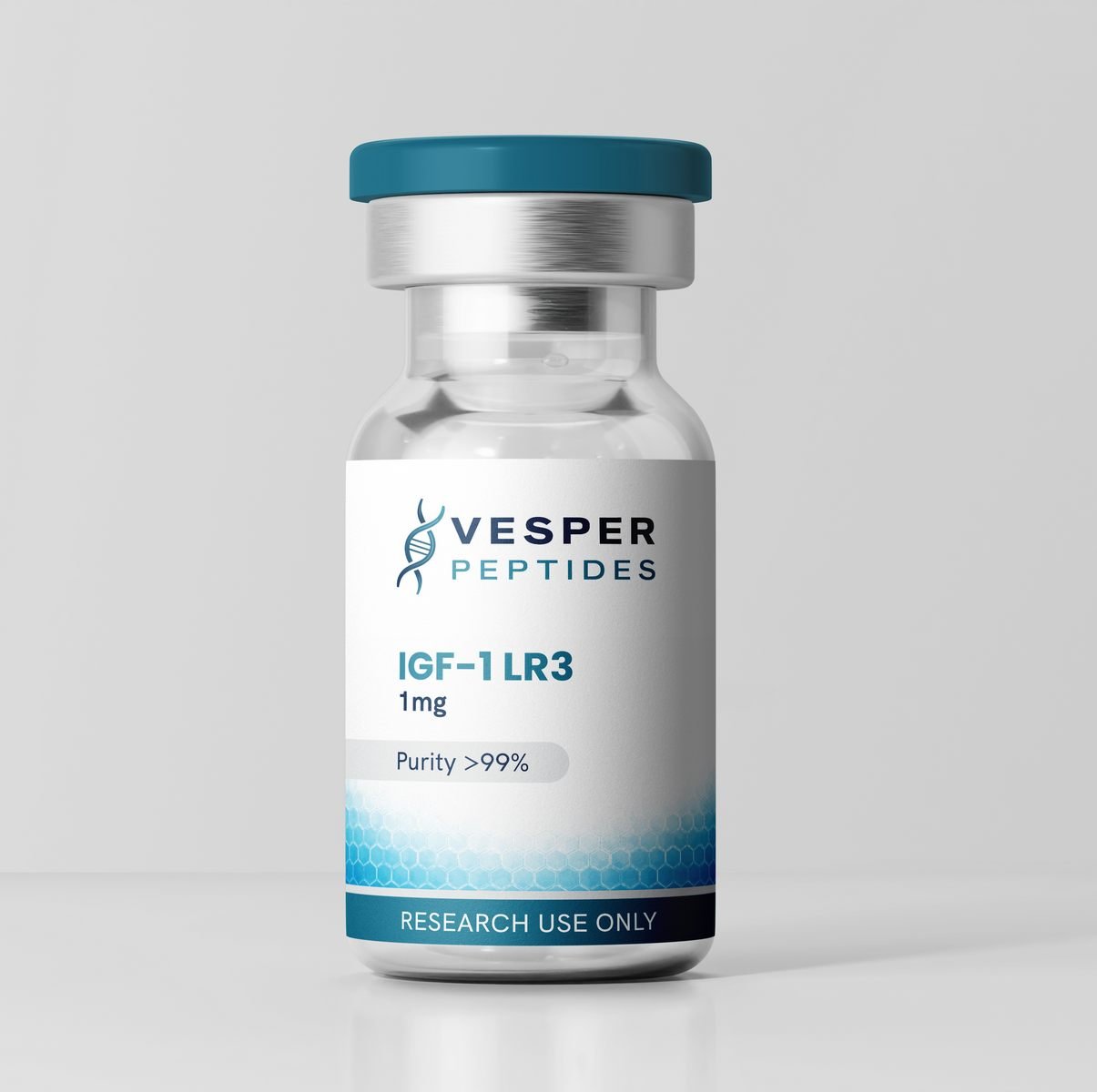
IGF-1 LR3 — Long-Acting IGF-1 Analogue Research Peptide
IGF-1 LR3 (Insulin-like Growth Factor-1 Long Arg3) is a recombinant, long-acting analogue of human IGF-1 incorporating two key structural modifications — a 13-amino acid N-terminal extension (Met-Lys-Gly-Pro-Glu-Thr-Leu-Cys-Gly-Ala-Glu-Leu-Val) and an arginine substitution at position 3 (Glu³→Arg³). Together, these modifications dramatically reduce IGF-1 LR3’s binding affinity for all six insulin-like growth factor binding proteins (IGFBP-1 through IGFBP-6), which normally sequester native IGF-1 and limit its bioavailability. Researchers in cell biology, muscle physiology, and GH/IGF-1 axis research use this IGF-1 LR3 research peptide to study IGF-1 receptor signaling, anabolic pathway activation, and myoblast biology in experimental systems where prolonged, unimpeded IGF-1R engagement is required. Furthermore, its IGFBP-resistant profile enables researchers to study pure IGF-1R-mediated biology without the confounding influence of endogenous binding protein sequestration.
Mechanism of Action
IGF-1 LR3 binds and activates the IGF-1 receptor (IGF-1R) — a receptor tyrosine kinase — with high affinity. Upon IGF-1R engagement, it triggers receptor autophosphorylation at multiple tyrosine residues. This activates two major downstream signaling cascades.
First, it activates the PI3K/AKT/mTOR pathway — the primary mediator of IGF-1-driven anabolic and cell survival responses. AKT phosphorylation downstream of PI3K activates mTORC1, which drives protein synthesis through S6K1 and 4EBP1 phosphorylation, and simultaneously inhibits FOXO-mediated protein catabolism. As a result, researchers use IGF-1 LR3 to model anabolic signaling, protein synthesis induction, and cellular growth responses in muscle and other IGF-1R-expressing cell systems.
Second, it activates the RAS/MAPK/ERK pathway, driving cell proliferation and differentiation responses. Consequently, IGF-1 LR3 supports studies of myoblast and satellite cell activation, proliferation kinetics, and differentiation into mature myotubes. Furthermore, its IGFBP-resistant modification ensures that these receptor-level effects occur without binding protein interference — a critical advantage in serum-containing cell culture systems where endogenous IGFBPs would otherwise neutralize native IGF-1.
Why Researchers Choose IGF-1 LR3 Over Native IGF-1
Native IGF-1 has a short effective half-life in biological systems due to rapid sequestration by IGFBPs. In serum-containing cell culture media, endogenous IGFBPs bind the majority of added native IGF-1 before it can reach IGF-1R on target cells. This severely limits its utility as a cell culture research tool. IGF-1 LR3 overcomes this limitation directly. Its reduced IGFBP binding affinity leaves it largely free in solution, enabling it to engage IGF-1R efficiently even in serum-supplemented culture conditions. Additionally, its N-terminal extension further extends its active half-life. Consequently, IGF-1 LR3 produces more reproducible and potent IGF-1R activation in cell-based assay systems than native IGF-1 at equivalent molar concentrations.
Key Research Applications
Researchers actively use IGF-1 LR3 across multiple cell biology and GH/IGF-1 axis research domains. Specifically, it supports:
- IGF-1 receptor signaling research — Characterization of IGF-1R autophosphorylation kinetics, IRS-1 phosphorylation, and downstream PI3K/AKT/mTOR and RAS/MAPK/ERK pathway activation in diverse IGF-1R-expressing cell lines and primary cell systems.
- Myoblast proliferation and differentiation research — Studies examining IGF-1R-driven satellite cell activation, myoblast proliferation kinetics, and myogenic differentiation into multinucleated myotubes in primary muscle cell culture systems.
- Anabolic signaling research — Investigation of mTORC1-mediated protein synthesis induction, S6K1 and 4EBP1 phosphorylation, and FOXO inhibition in skeletal muscle and other anabolically responsive cell systems.
- Cell survival and anti-apoptotic signaling — Studies examining AKT-mediated BAD phosphorylation, BCL-2 family regulation, and caspase inhibition in IGF-1R-dependent cell survival models.
- GH/IGF-1 axis downstream research — Studies examining the downstream cellular consequences of GH-stimulated hepatic IGF-1 production, using IGF-1 LR3 as a surrogate for circulating IGF-1 in target tissue cell culture models.
- Cancer biology research — Investigation of IGF-1R-mediated proliferation, survival, and resistance to apoptosis in tumour cell lines with known IGF-1R dependency or overexpression.
Peptide Profile
| Parameter | Detail |
|---|---|
| Common Name | IGF-1 LR3 |
| Full Name | Insulin-like Growth Factor-1 Long Arg3 |
| Key Modifications | 13-aa N-terminal extension + Glu³→Arg³ substitution |
| Receptor Target | IGF-1R (IGF-1 receptor tyrosine kinase) |
| IGFBP Binding | Dramatically reduced vs. native IGF-1 |
| Molecular Weight | ~9,117 Da |
| Form | Lyophilized powder |
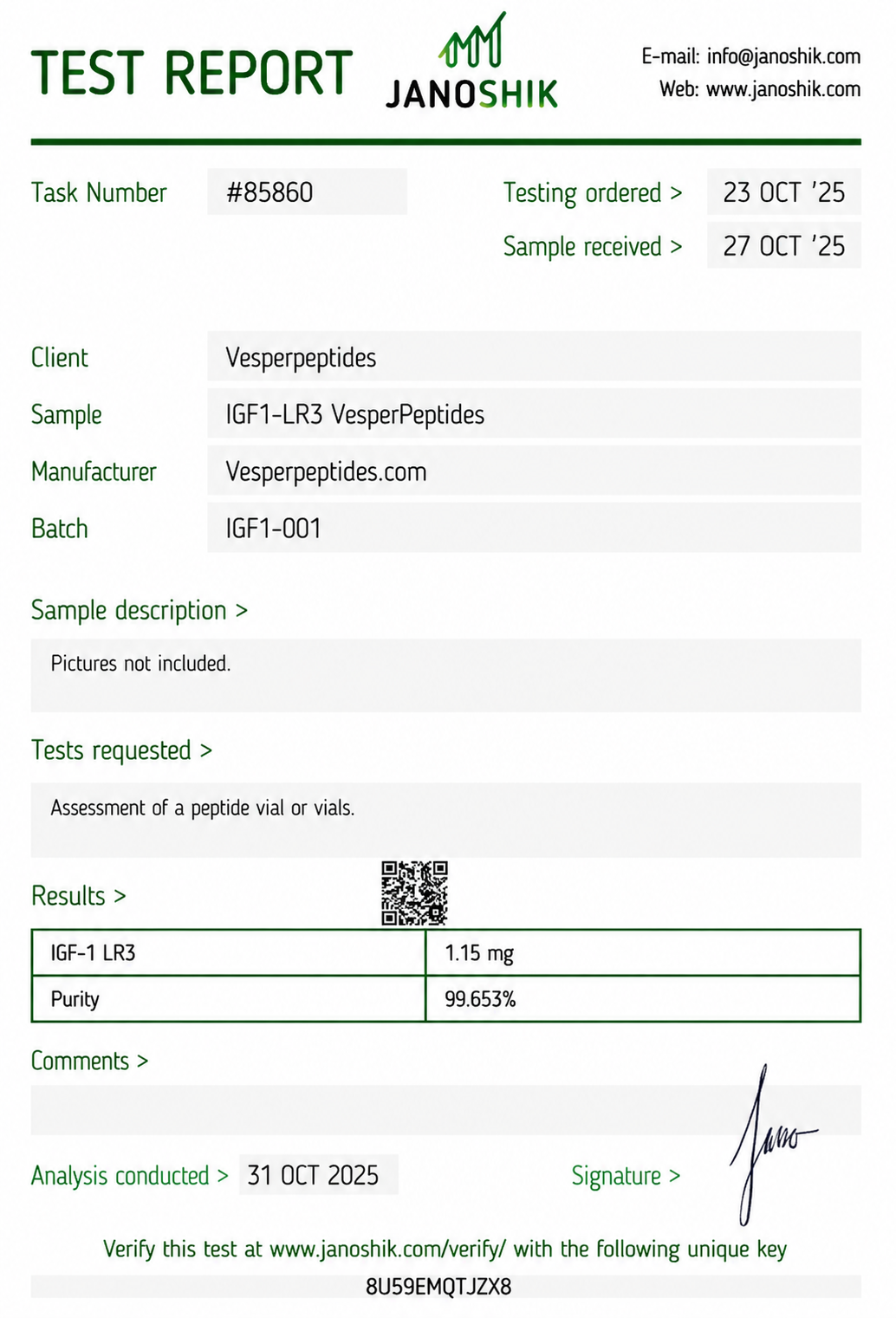
| Purity | ≥98% (HPLC verified) |
| Available Size | 1mg |
| Storage | −20°C (lyophilized); 4°C (reconstituted) |
| Reconstitution | 10mM HCl or dilute acetic acid (0.1%), then dilute in PBS |
Reconstitution Guidelines
Reconstitute IGF-1 LR3 by first adding a small volume (e.g., 100µl) of 10mM HCl or 0.1% acetic acid to the lyophilized powder. Swirl gently until dissolved. Then dilute to the desired working concentration with sterile PBS or cell culture medium. Do not add aqueous buffer directly to the lyophilized powder without the acidic solubilization step, as this may cause aggregation. Furthermore, prepare single-use aliquots at working concentration before storage at −20°C to avoid repeated freeze-thaw cycles. Use reconstituted working solutions within 48–72 hours when stored at 4°C.
Storage Conditions
Store lyophilized IGF-1 LR3 at −20°C, protected from direct light and moisture. Keep vials sealed until the point of reconstitution. Furthermore, concentrated stock solutions in dilute acetic acid store stably at −20°C for several months when properly aliquoted. Avoid repeated freeze-thaw cycles to preserve IGF-1R binding affinity and biological activity throughout the experimental program.
For research use only. Not intended for human or veterinary administration. This product is not a drug, supplement, or food product.
Reviews
There are no reviews yet.