
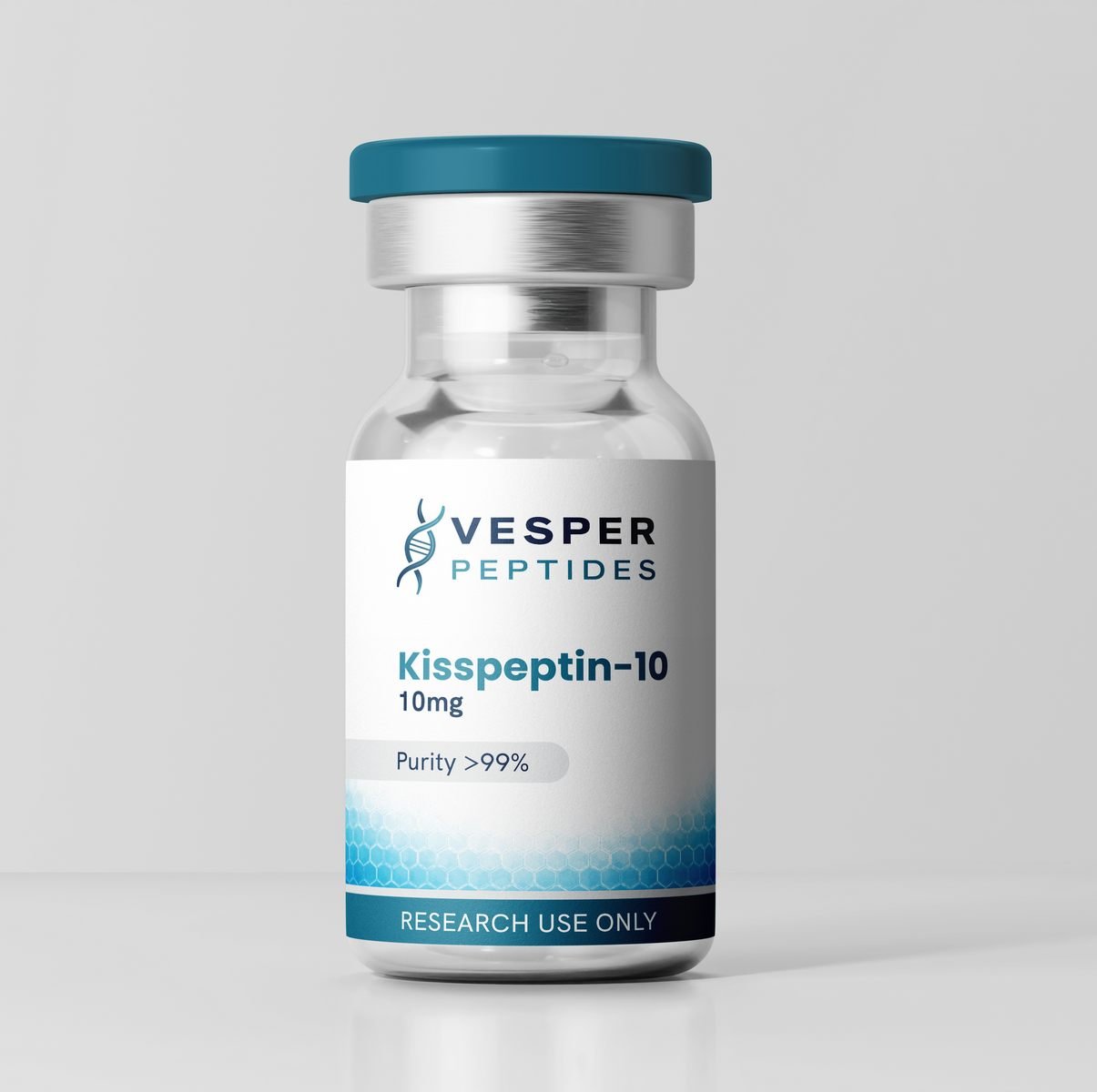
Kisspeptin-10 — KISS1R GPR54 Agonist Research Peptide
Kisspeptin-10 (Tyr-Asn-Trp-Asn-Ser-Phe-Gly-Leu-Arg-Phe-NH₂) is the C-terminal decapeptide of the kisspeptin family — neuropeptides encoded by the KISS1 gene and processed from a 145-amino acid precursor protein. It represents the minimum active fragment necessary for full KISS1R (GPR54) receptor activation. Researchers in reproductive neuroendocrinology, hypothalamic biology, and GnRH axis research use this Kisspeptin-10 research peptide as the primary tool compound for studying GnRH neuron activation, gonadotropin pulsatility regulation, and the central integration of metabolic and reproductive signals. Furthermore, its role as the key upstream activator of the GnRH pulse generator positions it at the apex of the hypothalamic-pituitary-gonadal (HPG) axis — making it uniquely critical in reproductive neuroendocrinology research.
Mechanism of Action
Kisspeptin-10 binds KISS1R (GPR54) — a Gq/11-coupled receptor expressed on GnRH neurons in the hypothalamic arcuate nucleus and anteroventral periventricular nucleus. Upon KISS1R activation, it triggers phospholipase C-mediated IP3 production and intracellular calcium mobilization. As a result, GnRH neurons depolarize and release GnRH in coordinated pulses into the hypothalamic-pituitary portal circulation.
Consequently, GnRH pulse generation drives pulsatile LH and FSH secretion from anterior pituitary gonadotroph cells. Therefore, Kisspeptin-10 functions as the master upstream activator of the entire HPG axis. Furthermore, KISS1R-expressing neurons integrate metabolic status signals — including leptin, insulin, and energy availability — and translate them into reproductive axis activation or suppression. This makes Kisspeptin-10 a critical tool for studying the metabolic-reproductive axis intersection.
Key Research Applications
- GnRH pulse generation research — Studies examining Kisspeptin-10-driven GnRH neuron depolarization, GnRH pulse frequency and amplitude, and KISS1R signal transduction in hypothalamic neuron models.
- LH and FSH regulation research — Investigation of HPG axis responses to Kisspeptin-10 stimulation, including LH pulse kinetics, FSH secretion, and gonadotroph sensitivity in pituitary cell systems.
- Puberty onset research — Studies examining KISS1 gene expression regulation, Kisspeptin-10 signaling during puberty initiation, and the neuroendocrine control of pubertal timing.
- Metabolic-reproductive axis research — Investigation of how metabolic signals including leptin and insulin modulate KISS1R neuron activity and downstream GnRH/LH pulsatility.
- Fertility and reproductive biology — Preclinical models studying Kisspeptin-10 effects on ovulation, spermatogenesis, and gonadal steroid feedback regulation.
Peptide Profile
| Parameter | Detail |
|---|---|
| Common Name | Kisspeptin-10 |
| Gene | KISS1 |
| Receptor Target | KISS1R / GPR54 (Gq/11-coupled) |
| Sequence | Tyr-Asn-Trp-Asn-Ser-Phe-Gly-Leu-Arg-Phe-NH₂ |
| Molecular Weight | ~1,302 Da |
| Form | Lyophilized powder |
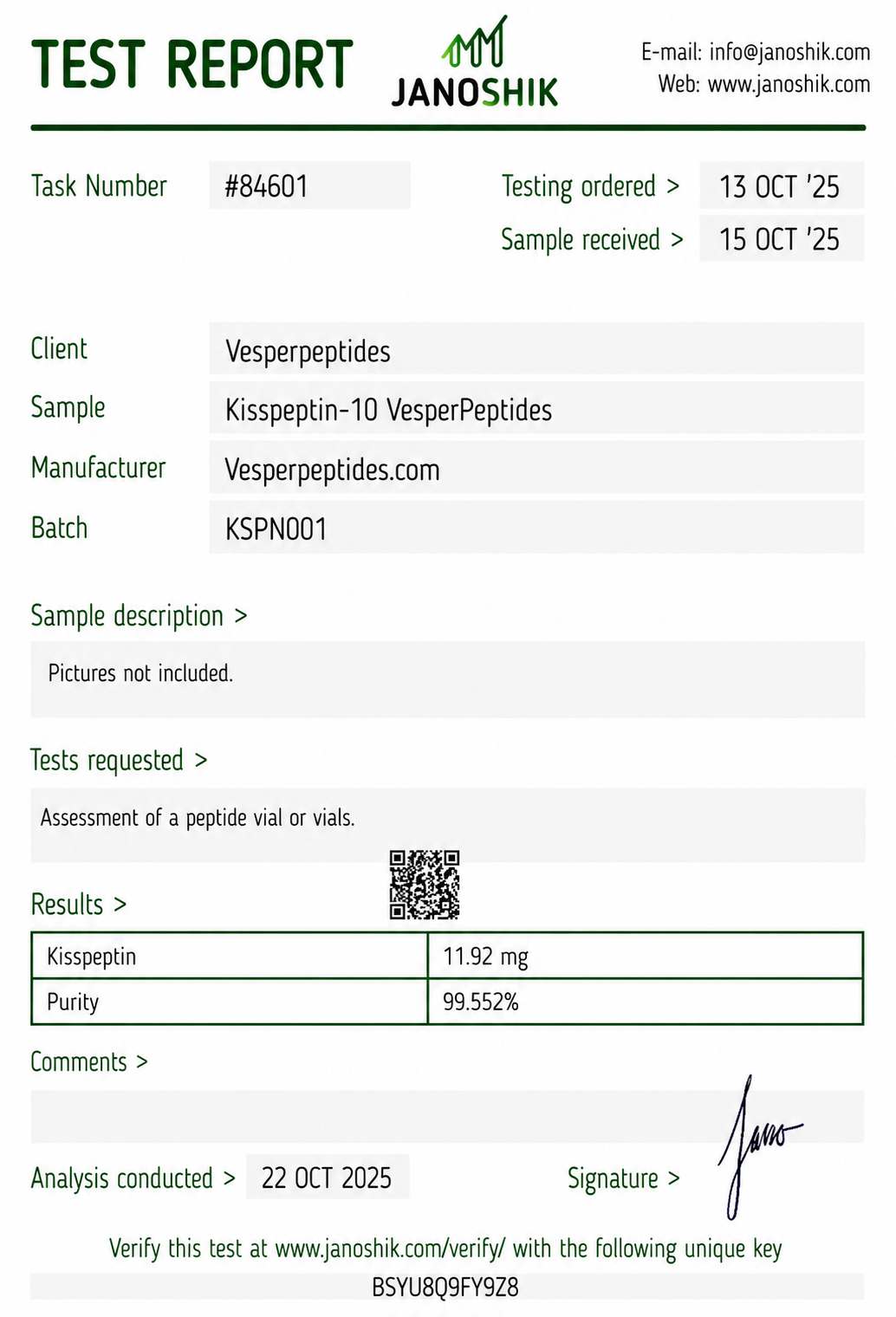
| Purity | ≥98% (HPLC verified) |
| Available Size | 10mg |
| Storage | −20°C (lyophilized); 4°C (reconstituted) |
| Reconstitution | Sterile bacteriostatic water |
Reconstitution & Storage
Reconstitute with sterile bacteriostatic water. Swirl gently until dissolved. Store lyophilized vials at −20°C. Once reconstituted, maintain at 4°C and use within 28 days. Avoid repeated freeze-thaw cycles.
For research use only. Not intended for human or veterinary administration.

Reviews
There are no reviews yet.