
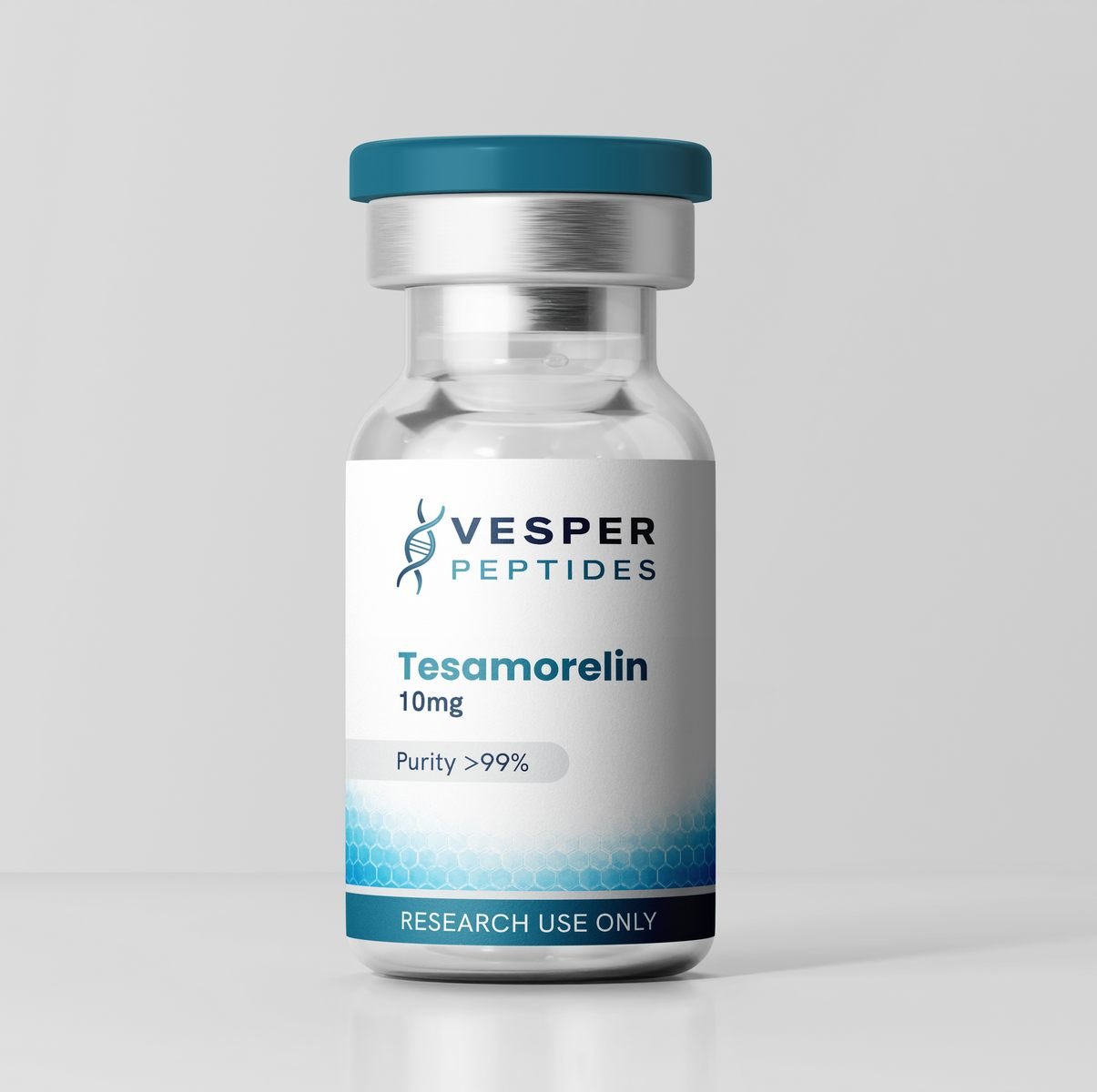
Tesamorelin — Stabilized GHRH(1-44) Analogue Research Peptide
Tesamorelin is a synthetic stabilized analogue of full-length human GHRH(1–44) in which the native peptide is conjugated to trans-2-hexenoic acid at the N-terminus. This modification protects the peptide from DPP-IV cleavage at the Ala²-Asp³ bond — the primary site of rapid native GHRH degradation — thereby significantly extending its active half-life and bioavailability compared to unmodified GHRH(1–44). Researchers in endocrinology, metabolic biology, and GH axis pharmacology use this tesamorelin research peptide to study sustained GHRH receptor activation, visceral adiposity mechanisms, and lipodystrophy-related metabolic research. Furthermore, as the only full-length GHRH analogue in the growth hormone peptides research category, it provides a unique structural perspective on GHRHR pharmacology that truncated fragments such as Sermorelin and CJC-1295 cannot replicate.
Mechanism of Action
Tesamorelin binds and activates the GHRH receptor (GHRHR) on anterior pituitary somatotroph cells with high affinity. Upon GHRHR engagement, it activates Gs-protein coupled adenylyl cyclase signaling, elevates intracellular cAMP and PKA, and directly stimulates GH synthesis and secretion. Its trans-2-hexenoic acid N-terminal conjugation prevents DPP-IV-mediated cleavage, extending its circulating half-life substantially beyond native GHRH while maintaining a defined, intermediate pharmacokinetic profile — longer than Sermorelin but shorter than CJC-1295 with DAC.
Consequently, Tesamorelin produces a sustained but time-limited GHRHR stimulation pattern. This results in measurable and reproducible elevations in circulating GH and downstream IGF-1 levels across extended experimental timeframes. Furthermore, GH elevation driven by Tesamorelin specifically promotes lipolysis in visceral adipose tissue depots through GH receptor-mediated hormone-sensitive lipase activation. Therefore, researchers studying the GH-mediated regulation of visceral fat specifically favour Tesamorelin over shorter-acting GHRH fragments for their experimental models.
Tesamorelin in Visceral Adiposity and Lipodystrophy Research
Tesamorelin has accumulated one of the most extensive preclinical and clinical research profiles of any GHRH analogue, particularly in the context of visceral adiposity and lipodystrophy research. Its ability to stimulate GH and IGF-1 production in a sustained, reproducible manner makes it an ideal tool compound for studies examining:
GH-mediated visceral fat reduction mechanisms — specifically, how GH receptor activation in visceral adipose tissue depots drives triglyceride lipolysis through hormone-sensitive lipase phosphorylation and adipokine regulation. Additionally, researchers use Tesamorelin to model the metabolic consequences of GH deficiency states — including increased visceral adiposity, dyslipidaemia, and insulin sensitivity changes — by examining the reversal of these parameters upon GHRHR re-stimulation in preclinical GH-deficient model systems.
Key Research Applications
Researchers actively use Tesamorelin across multiple GH axis and metabolic research domains. Specifically, it supports:
- Visceral adiposity research — Preclinical studies investigating GH-mediated lipolysis in visceral adipose tissue depots, including omental and mesenteric fat compartments, using Tesamorelin as a sustained GHRHR stimulatory agent.
- Lipodystrophy mechanism research — Studies modelling lipodystrophy-associated fat redistribution, visceral fat accumulation, and metabolic dysregulation in preclinical systems, using Tesamorelin-driven GH stimulation to investigate reversal mechanisms.
- GH and IGF-1 axis kinetics — Investigation of the time-course of GH secretion, hepatic IGF-1 production, and circulating IGF-1 accumulation under sustained GHRHR activation with Tesamorelin as the stimulatory compound.
- Full-length GHRH pharmacology — Studies requiring the complete GHRH(1–44) sequence for receptor binding studies, structural pharmacology research, or comparison against truncated GHRH fragments to identify residues contributing to receptor affinity and signaling efficacy.
- Comparative GHRH analogue research — Experimental designs benchmarking Tesamorelin against Sermorelin, CJC-1295 (No DAC), and CJC-1295 (With DAC) to characterize how sequence length and structural modifications affect GHRHR pharmacodynamics and downstream GH/IGF-1 responses.
- Metabolic syndrome research — Studies examining GH axis contributions to dyslipidaemia, insulin resistance, and body composition changes in metabolic syndrome preclinical models using Tesamorelin as a GH secretagogue research tool.
Peptide Profile
| Parameter | Detail |
|---|---|
| Common Name | Tesamorelin |
| Full Name | Trans-2-hexenoic acid-GHRH(1-44) |
| Sequence Length | 44 amino acids + N-terminal conjugate |
| Receptor Target | GHRH receptor (GHRHR) |
| Mechanism Class | Stabilized full-length GHRH analogue |
| Molecular Weight | ~5,135 Da |
| Form | Lyophilized powder |
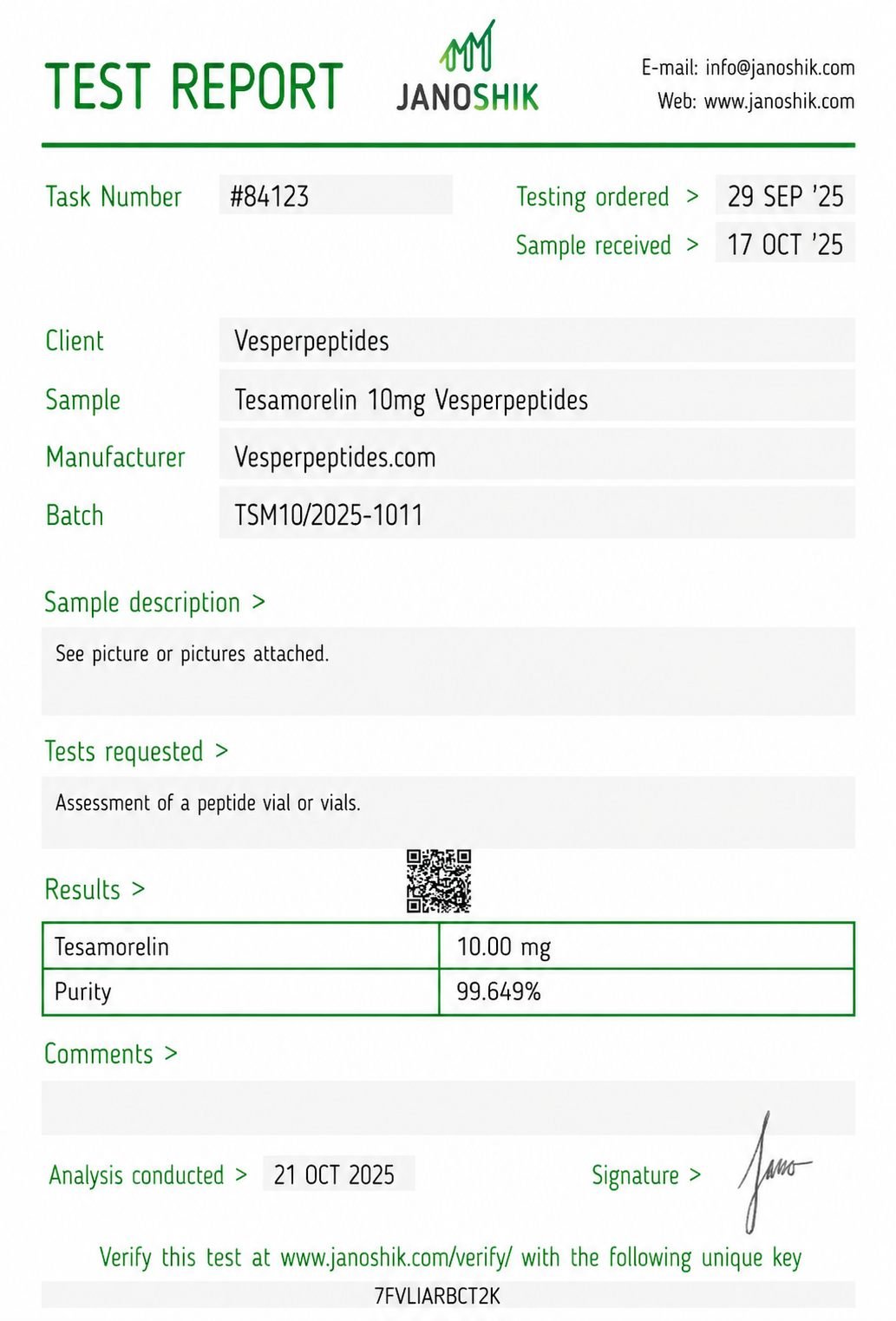
| Purity | ≥98% (HPLC verified) |
| Available Size | 10mg |
| Storage | −20°C (lyophilized); 4°C (reconstituted) |
| Reconstitution | Sterile bacteriostatic water |
Reconstitution Guidelines
Reconstitute Tesamorelin with sterile bacteriostatic water. Add solvent slowly along the inner vial wall and gently swirl until the lyophilized powder fully dissolves. Do not shake or vortex. For a 10mg vial, researchers typically add 1–2ml of solvent to achieve a suitable working concentration for their assay system. Furthermore, prepare single-use aliquots before storage at 4°C to minimize repeated freeze-thaw exposure across multi-session experimental protocols.
Storage Conditions
Store lyophilized Tesamorelin vials at −20°C, protected from direct light and moisture. Additionally, keep vials sealed until the point of reconstitution to preserve lyophilized stability. Once reconstituted, maintain at 4°C and use within 28–30 days. Avoid repeated freeze-thaw cycles to preserve GHRHR binding affinity and peptide integrity throughout the study duration.
For research use only. Not intended for human or veterinary administration. This product is not a drug, supplement, or food product.
Reviews
There are no reviews yet.