
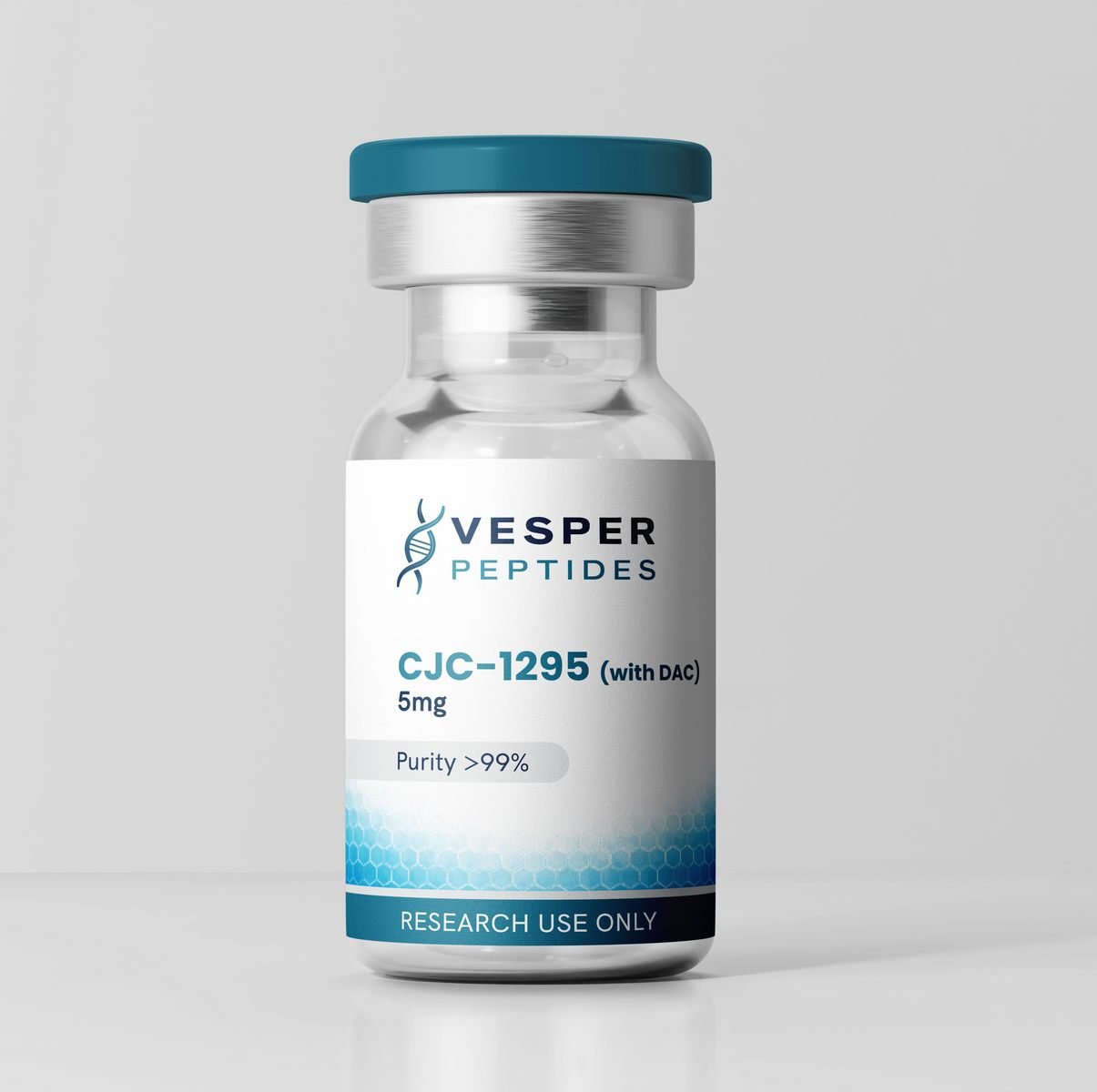
CJC-1295 (With DAC) — Long-Acting Albumin-Binding GHRH Analogue Research Peptide
CJC-1295 with DAC is a synthetic GHRH analogue engineered with Drug Affinity Complex (DAC) technology — a maleimide-based reactive group that forms a covalent bond with circulating albumin upon administration. This albumin-binding mechanism dramatically extends the peptide’s active half-life from hours to days, enabling sustained, continuous GHRH receptor activation over extended experimental timeframes. Researchers in endocrinology, pituitary biology, and growth hormone axis research use this CJC-1295 with DAC research peptide specifically in protocols requiring prolonged GH elevation rather than the defined, pulsatile stimulation that shorter-acting GHRH analogues produce. Furthermore, its extended pharmacokinetic profile opens research applications that are simply not achievable with conventional GHRH analogues.
Mechanism of Action
CJC-1295 with DAC binds the GHRH receptor (GHRHR) on anterior pituitary somatotroph cells with high affinity, activating Gs-protein coupled adenylyl cyclase signaling and elevating intracellular cAMP and PKA activity. This directly stimulates GH synthesis and secretion. However, what distinguishes this compound from CJC-1295 without DAC is its DAC technology component.
The maleimide group on the DAC moiety reacts spontaneously with the free thiol group of Cys34 on circulating albumin, forming a stable covalent thioether bond. As a result, the peptide effectively uses albumin as a long-lived carrier molecule. Additionally, this albumin conjugation protects the peptide from proteolytic degradation and renal clearance. Consequently, a single administration maintains active GHRHR stimulation and sustained GH elevation over a period of days rather than hours — a pharmacokinetic profile uniquely suited to long-duration research protocols.
CJC-1295 With DAC vs. Without DAC — Selecting the Right Research Tool
The two CJC-1295 variants share the same GHRHR target and the same four stabilizing amino acid substitutions. However, they serve fundamentally different experimental purposes due to their contrasting pharmacokinetic profiles.
CJC-1295 (No DAC) produces defined, time-limited GH pulses. Researchers use it when they need precise control over GH stimulation timing — for example, in studies examining GH pulse amplitude, pituitary responsiveness, or the acute downstream effects of GH secretion on target tissues.
CJC-1295 (With DAC), by contrast, maintains continuous GHRHR activation and sustained circulating GH levels over days. Therefore, researchers choose it for studies examining the long-term consequences of GH elevation — including IGF-1 accumulation kinetics, chronic somatotropic axis modulation, anabolic signaling over extended timeframes, and steady-state GH/IGF-1 axis equilibrium. Both variants are available separately to give researchers complete flexibility across the full spectrum of GH axis research designs.
Key Research Applications
Researchers actively use CJC-1295 with DAC across multiple long-duration growth hormone research domains. Specifically, it supports:
- Sustained GH elevation studies — Preclinical models examining the physiological and molecular consequences of prolonged GH receptor activation on target tissues including liver, muscle, bone, and adipose tissue.
- IGF-1 accumulation kinetics — Studies investigating the time-course of hepatic IGF-1 production and circulating IGF-1 accumulation in response to continuous GHRHR stimulation over extended experimental periods.
- Long-term somatotropic axis modulation — Research examining pituitary somatotroph adaptation, GHRHR regulation, and GH secretory capacity following sustained GHRH receptor engagement.
- Anabolic signaling research — Investigation of GH/IGF-1-mediated protein synthesis, nitrogen retention, and skeletal muscle anabolic pathway activation under conditions of prolonged GH elevation.
- Albumin-binding peptide pharmacokinetics — Studies using CJC-1295 with DAC as a model compound to characterize DAC technology pharmacokinetics, albumin conjugation efficiency, and in vivo half-life extension mechanisms.
- Comparative GH secretagogue research — Experimental designs comparing continuous GHRHR activation (CJC-1295 with DAC) against pulsatile stimulation (CJC-1295 No DAC, Sermorelin) and GHSR-1a agonism (GHRP-6, Hexarelin) to map the differential downstream consequences of each stimulation pattern.
Peptide Profile
| Parameter | Detail |
|---|---|
| Common Name | CJC-1295 With DAC |
| Also Known As | CJC-1295, DAC:GRF |
| Receptor Target | GHRH receptor (GHRHR) |
| Mechanism Class | Long-acting albumin-binding GHRH analogue |
| DAC Technology | Maleimide-Cys34 albumin covalent binding |
| Molecular Weight | ~3,647 Da |
| Form | Lyophilized powder |
| Purity | ≥98% (HPLC verified) |
| Available Size | 5mg |
| Storage | −20°C (lyophilized); 4°C (reconstituted) |
| Reconstitution | Sterile bacteriostatic water |
Reconstitution Guidelines
Reconstitute CJC-1295 with DAC using sterile bacteriostatic water. Add solvent slowly along the inner vial wall and gently swirl until the lyophilized powder fully dissolves. Do not shake or vortex. For a 5mg vial, researchers typically add 1–2ml of solvent to achieve a suitable working concentration. Furthermore, prepare single-use aliquots before storage at 4°C to minimize repeated freeze-thaw exposure, particularly important in longer experimental programs where vial contents are accessed across multiple sessions.
Storage Conditions
Store lyophilized CJC-1295 with DAC vials at −20°C, protected from direct light and moisture. Additionally, keep vials sealed until the point of reconstitution to preserve lyophilized stability. Once reconstituted, maintain at 4°C and use within 28–30 days. Avoid repeated freeze-thaw cycles to preserve DAC conjugation integrity and GHRHR binding activity throughout the study duration.
For research use only. Not intended for human or veterinary administration. This product is not a drug, supplement, or food product.
Reviews
There are no reviews yet.