
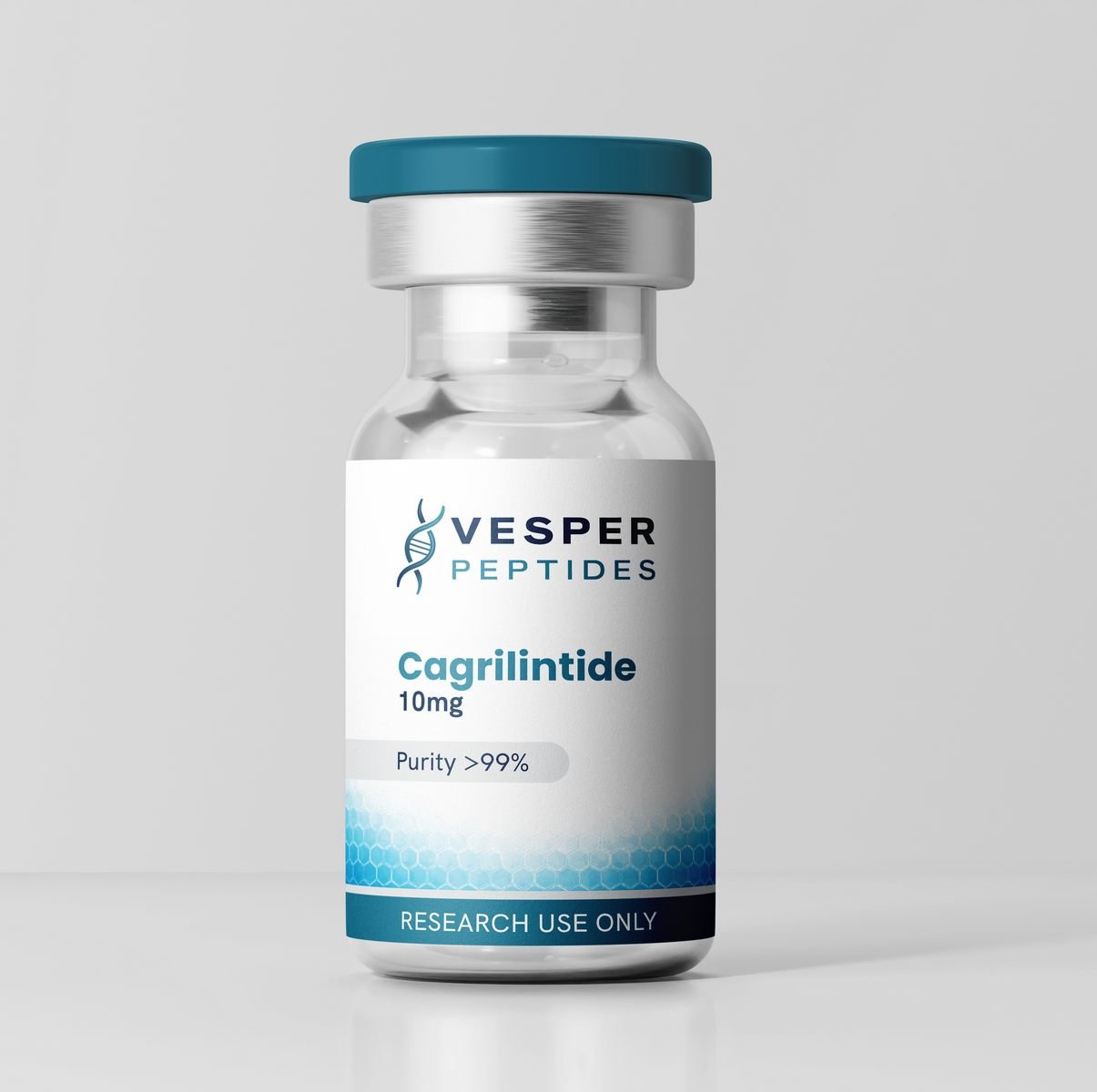
Cagrilintide — Long-Acting Amylin Analogue Research Peptide
Cagrilintide is a synthetic, fatty acid-modified amylin analogue engineered for prolonged receptor engagement and extended plasma stability. Researchers in metabolic biology, neuroendocrinology, and pharmacology use it as a primary tool compound for studying amylin receptor signaling, satiety pathway modulation, and energy homeostasis regulation. Furthermore, its complementary mechanism of action alongside GLP-1 receptor agonists makes it an important tool in dual-hormone metabolic research protocols. This cagrilintide research peptide ships as a 10mg lyophilized vial at verified research-grade purity.
Mechanism of Action
Cagrilintide binds and activates amylin receptors — specifically AMY1, AMY2, and AMY3 — which are heterodimeric complexes of the calcitonin receptor (CTR) and receptor activity-modifying proteins (RAMP1, RAMP2, RAMP3). It also engages the calcitonin receptor directly. As a result, it activates multiple downstream signaling cascades including cAMP/PKA, MAPK, and PI3K pathways in amylin-responsive tissues.
Amylin receptor activation in the area postrema and nucleus tractus solitarius of the brainstem drives satiety signaling and food intake suppression. Additionally, cagrilintide modulates gastric emptying rate and suppresses post-prandial glucagon secretion through amylinergic pathways. Consequently, researchers use it to dissect the specific contributions of amylin receptor signaling to energy balance — independently of GLP-1R or insulin receptor pathways.
Its fatty acid modification enables albumin binding, which significantly extends its circulating half-life compared to native amylin. Therefore, experimental protocols requiring sustained amylin receptor activation over days rather than hours specifically benefit from this long-acting amylin peptide research compound.
Key Research Applications
Researchers actively use Cagrilintide across several specialized research domains. Specifically, it supports:
- Amylin receptor pharmacology — Characterization of AMY1–3 receptor binding kinetics, downstream cAMP signaling, and RAMP-dependent receptor complex pharmacology in cell-based systems.
- Satiety and food intake research — Investigation of amylinergic satiety circuits in the brainstem area postrema and nucleus tractus solitarius using in vivo and ex vivo neuronal models.
- Energy balance studies — Preclinical models examining the contribution of amylin receptor activation to total energy expenditure, food intake suppression, and body weight regulation.
- Glucagon suppression research — Studies investigating amylin-mediated post-prandial glucagon inhibition from pancreatic alpha-cells and its impact on glucose excursion profiles.
- Dual-hormone combination research — Experimental protocols pairing Cagrilintide with GLP-1R agonists such as Semaglutide (GLP-1S) to study complementary and additive satiety and metabolic signaling effects. See also the Cagrilintide + Semaglutide combination product.
- Gastric motility studies — Investigation of amylinergic effects on gastric emptying rate and gastrointestinal transit in preclinical model systems.
Complementary Role in GLP-1 Research Protocols
GLP-1 receptor agonists primarily activate satiety circuits through hypothalamic GLP-1R signaling. Amylin, however, activates a distinct and complementary brainstem satiety pathway. Consequently, researchers studying the complete landscape of hormonal satiety regulation need both receptor systems represented in their experimental design. Cagrilintide provides precisely that — a well-characterized, long-acting amylin analogue research compound that enables researchers to model amylinergic signaling alongside or independent of GLP-1R agonism.
Furthermore, the Cagrilintide + Semaglutide combination product (available separately) provides both mechanisms in a single formulation for researchers running combined pathway protocols.
Peptide Profile
| Parameter | Detail |
|---|---|
| Common Name | Cagrilintide |
| Receptor Targets | AMY1R, AMY2R, AMY3R, CTR |
| Agonist Class | Long-acting amylin analogue |
| Form | Lyophilized powder |
| Purity | ≥98% (HPLC verified) |
| Available Size | 10mg |
| Storage | −20°C (lyophilized); 4°C (reconstituted) |
| Reconstitution | Sterile bacteriostatic water |
Reconstitution Guidelines
Reconstitute Cagrilintide with sterile bacteriostatic water. Add solvent slowly along the inner vial wall and gently swirl until fully dissolved. Do not shake or vortex. For a 10mg vial, researchers typically add 1–2ml of solvent to achieve a suitable working concentration for most assay systems. Additionally, prepare single-use aliquots before storage to reduce freeze-thaw exposure in protocols extending beyond a single experimental session.
Storage Conditions
Store lyophilized Cagrilintide vials at −20°C, protected from direct light and moisture. Furthermore, keep vials sealed until the point of reconstitution. Once reconstituted, maintain at 4°C and use within 28–30 days. Avoid repeated freeze-thaw cycles, as these progressively compromise peptide activity and receptor binding affinity.
For research use only. Not intended for human or veterinary administration. This product is not a drug, supplement, or food product.
Reviews
There are no reviews yet.