
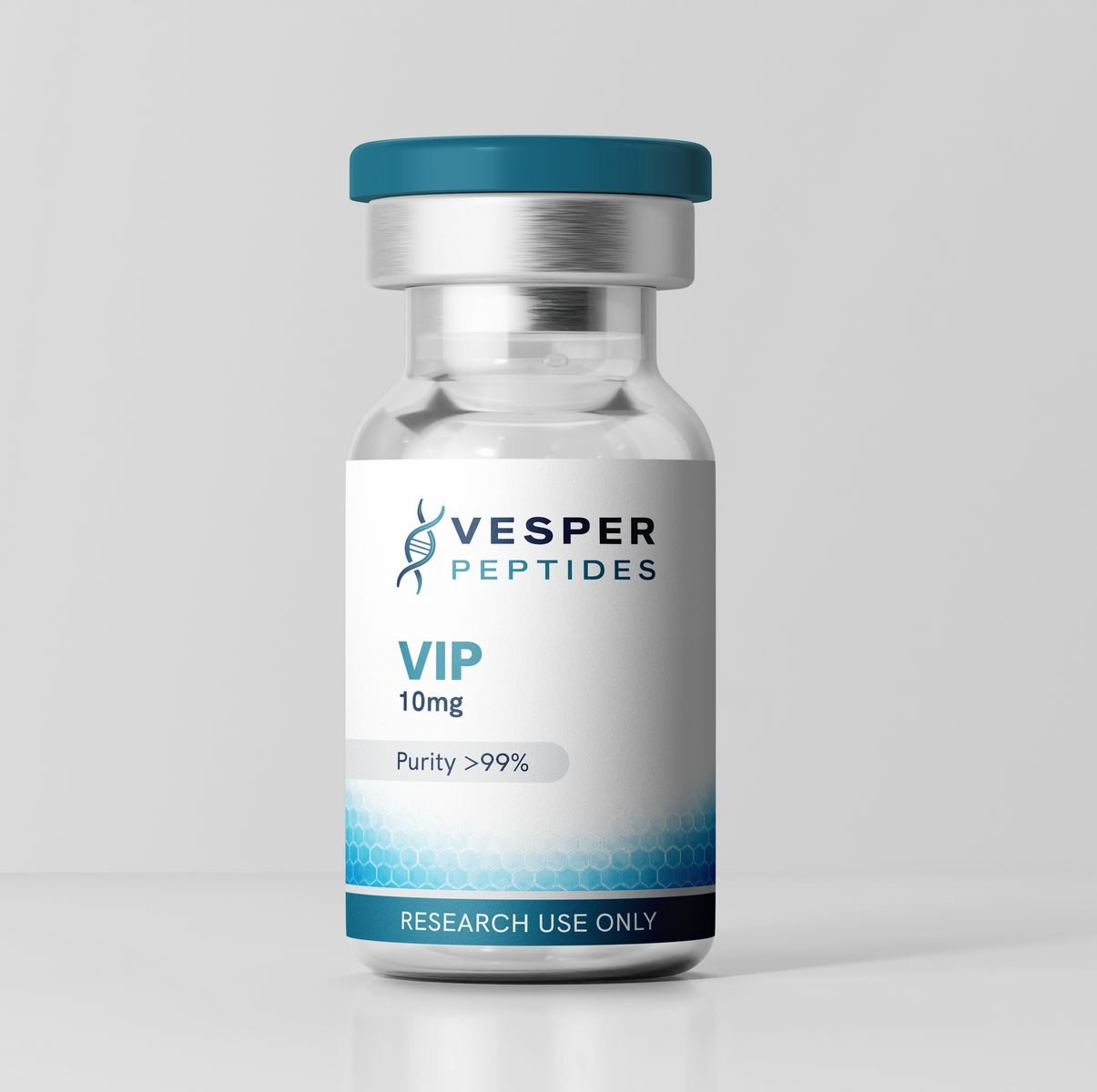
VIP — Vasoactive Intestinal Peptide Anti-Inflammatory Neuropeptide Research Compound
VIP (Vasoactive Intestinal Peptide) is a 28-amino acid neuropeptide belonging to the glucagon/secretin superfamily of peptide hormones. It is widely expressed in the central and peripheral nervous systems, immune tissues, and gastrointestinal tract. Researchers in neuroimmunology, autoimmune disease biology, pulmonary research, and neuroprotection science use this VIP vasoactive intestinal peptide research compound to study VPAC receptor signaling, anti-inflammatory pathway regulation, and regulatory T-cell biology. Furthermore, VIP’s remarkable anti-inflammatory potency — demonstrated across diverse inflammatory disease models — establishes it as one of the most physiologically significant endogenous anti-inflammatory neuropeptides available as a research tool compound.
Mechanism of Action
VIP signals through two G-protein coupled receptors — VPAC1 (expressed ubiquitously) and VPAC2 (expressed predominantly in smooth muscle and lymphocytes). Both receptors couple to Gs proteins, activating adenylyl cyclase and elevating intracellular cAMP through PKA-dependent signaling cascades. As a result, VIP produces broad downstream effects across immune, neural, and smooth muscle target cell populations.
Anti-inflammatory signaling — VIP potently suppresses pro-inflammatory cytokine production including TNF-α, IL-6, IL-12, and IL-1β in macrophages and dendritic cells through cAMP/PKA-mediated NF-κB inhibition. Additionally, it upregulates anti-inflammatory cytokines including IL-10 and TGF-β. Consequently, researchers studying inflammatory resolution and anti-inflammatory signaling specifically use VIP as a benchmark endogenous anti-inflammatory neuropeptide.
Regulatory T-cell biology — VIP actively promotes regulatory T-cell (Treg) differentiation and function through VPAC receptor signaling in T-lymphocytes. Furthermore, it shifts Th1/Th2 balance toward tolerogenic phenotypes. Therefore, researchers studying autoimmune disease mechanisms and immune tolerance specifically include VIP in their experimental systems.
Neuroprotection — VIP demonstrates neuroprotective effects in CNS injury and neurodegeneration models through direct neuronal VPAC receptor activation and indirect anti-neuroinflammatory effects. As a result, it serves as a research tool for studying neuropeptide-mediated CNS protection mechanisms.
Pulmonary biology — VIP produces potent bronchodilatory effects through VPAC1 and VPAC2 activation in airway smooth muscle. Additionally, it suppresses pulmonary inflammation and modulates airway immune responses. Consequently, researchers use it in asthma, pulmonary fibrosis, and airway inflammation research models.
Key Research Applications
- VPAC receptor pharmacology — Characterization of VPAC1 and VPAC2 binding kinetics, cAMP signaling profiles, and receptor subtype-specific downstream effector activation in diverse cell systems.
- Anti-inflammatory research — Studies examining VIP-driven suppression of TNF-α, IL-6, and IL-12 production, NF-κB inhibition, and IL-10/TGF-β upregulation in macrophage and DC systems.
- Regulatory T-cell research — Investigation of VIP-driven Treg differentiation, Foxp3 expression, and immune tolerance mechanisms in T-lymphocyte culture systems.
- Autoimmune disease research — Preclinical models examining VIP effects on autoimmune disease pathogenesis, inflammatory resolution, and immune homeostasis restoration.
- Pulmonary inflammation research — Studies examining VIP bronchodilatory effects, airway smooth muscle relaxation, and pulmonary immune modulation in airway inflammation models.
- Neuroprotection research — Investigation of VIP neuroprotective effects in CNS injury, neuroinflammation, and neurodegeneration preclinical model systems.
Peptide Profile
| Parameter | Detail |
|---|---|
| Common Name | VIP |
| Full Name | Vasoactive Intestinal Peptide |
| Receptor Targets | VPAC1, VPAC2 (Gs-coupled) |
| Peptide Family | Glucagon/secretin superfamily |
| Sequence Length | 28 amino acids |
| Molecular Weight | ~3,326 Da |
| Form | Lyophilized powder |
| Purity | ≥98% (HPLC verified) |
| Available Size | 10mg |
| Storage | −20°C (lyophilized); 4°C (reconstituted) |
| Reconstitution | Sterile bacteriostatic water |
Reconstitution & Storage
Reconstitute with sterile bacteriostatic water. Add solvent slowly along the inner vial wall and swirl gently until fully dissolved. Do not vortex. Store lyophilized vials at −20°C, protected from light and moisture. Once reconstituted, maintain at 4°C and use within 28 days. Avoid repeated freeze-thaw cycles to preserve VPAC receptor binding activity throughout the experimental program.
For research use only. Not intended for human or veterinary administration. This product is not a drug, supplement, or food product.
Reviews
There are no reviews yet.