
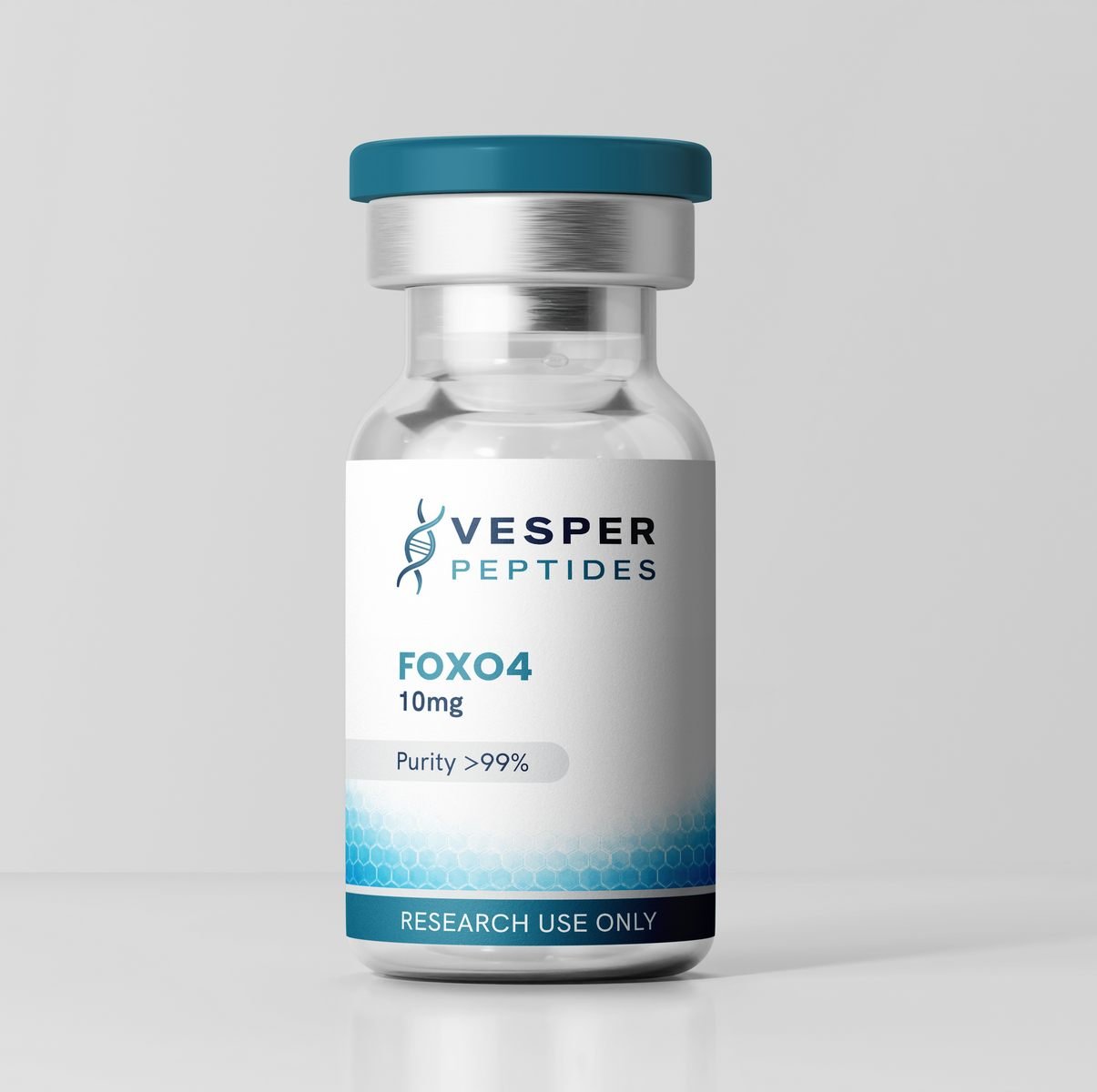
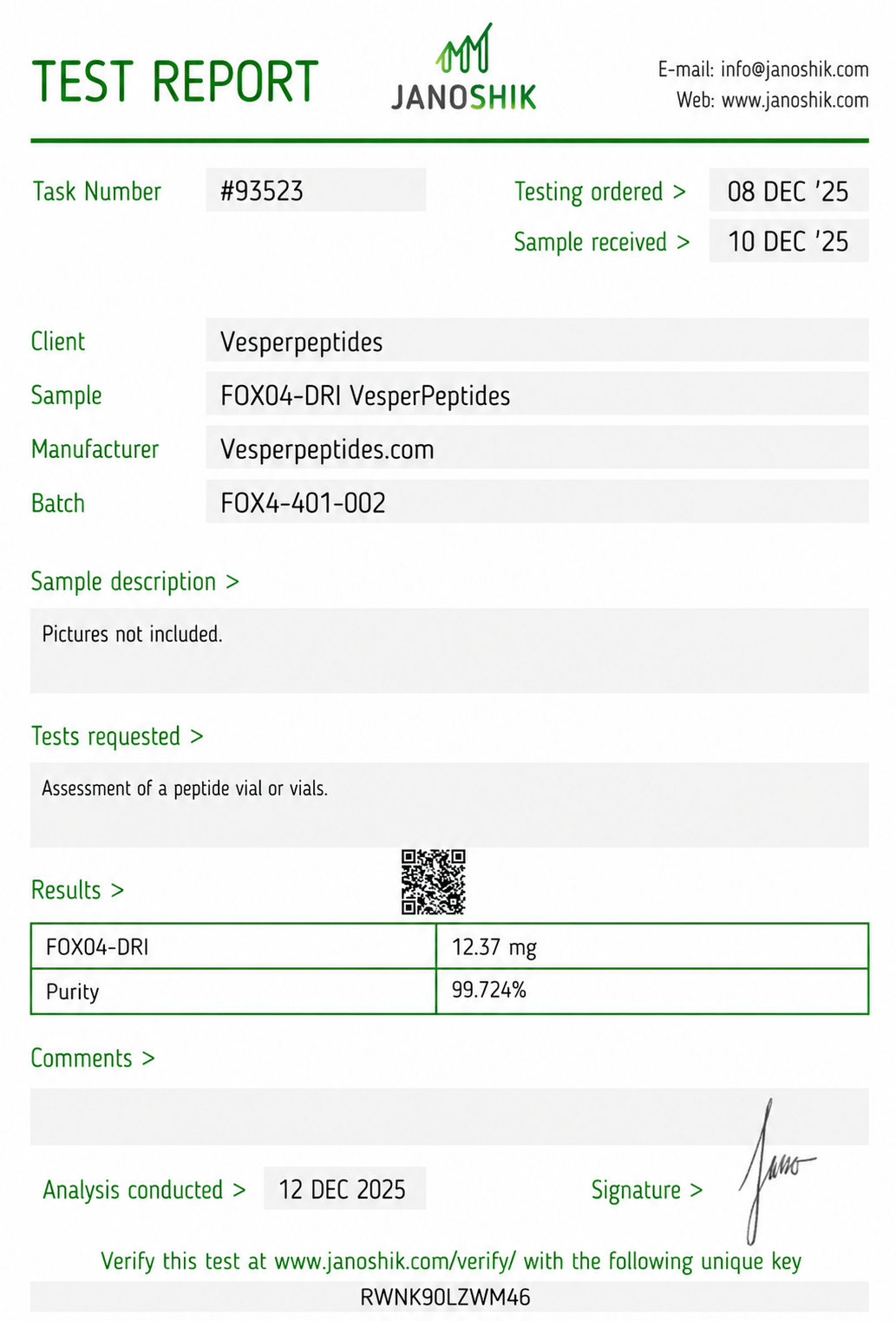
FOXO4-DRI — Senolytic Research Peptide for Cellular Senescence Research
FOXO4-DRI is a synthetic retro-inverso peptide — incorporating D-amino acids in reverse sequence — that competitively disrupts the protein-protein interaction between FOXO4 transcription factor and p53 tumor suppressor protein in senescent cells. Researchers in geroscience, cellular senescence biology, and aging research use this FOXO4-DRI research peptide as a mechanistically precise senolytic tool compound for studying senescent cell apoptosis, p53 pathway restoration, and tissue rejuvenation mechanisms. Furthermore, its selectivity for senescent cells — which depend on the FOXO4-p53 interaction for survival — over healthy proliferating cells makes it one of the most targeted senolytic research compounds currently available.
Mechanism of Action
In senescent cells, FOXO4 translocates to the nucleus and sequesters p53 through a direct protein-protein interaction. This sequestration prevents p53 from activating its pro-apoptotic transcriptional program — specifically, p53-driven upregulation of PUMA, BAX, and other pro-apoptotic BCL-2 family members. As a result, senescent cells evade apoptosis and persist in tissues, driving chronic inflammation and tissue dysfunction through the senescence-associated secretory phenotype (SASP).
FOXO4-DRI competitively occupies the p53-binding domain of FOXO4. Consequently, it displaces p53 from its interaction with FOXO4 and releases p53 to freely activate its pro-apoptotic transcriptional targets. As a result, senescent cells undergo p53-dependent apoptosis — a process that does not occur in healthy proliferating or quiescent cells that lack FOXO4-p53 nuclear co-localization. Therefore, researchers use FOXO4-DRI as a selective senescent cell elimination tool in cellular senescence clearance and tissue rejuvenation research.
Key Research Applications
- Senescent cell apoptosis research — Studies examining FOXO4-DRI-driven p53 nuclear release, pro-apoptotic gene upregulation, and selective senescent cell elimination in aged primary cell cultures.
- FOXO4-p53 interaction research — Biochemical studies characterizing the FOXO4-p53 protein-protein interaction using FOXO4-DRI as a competitive disruptor reference compound in co-immunoprecipitation and proximity ligation assay systems.
- SASP modulation research — Studies investigating how senescent cell clearance by FOXO4-DRI reduces SASP-driven pro-inflammatory cytokine production and paracrine tissue dysfunction.
- Tissue rejuvenation biology — Preclinical aging models examining tissue function restoration, physical performance improvement, and regenerative capacity enhancement following senescent cell clearance.
- Comparative senolytic research — Experimental designs benchmarking FOXO4-DRI against other senolytic approaches including navitoclax and quercetin to characterize mechanism-specific differences in senescent cell targeting selectivity.
Peptide Profile
| Parameter | Detail |
|---|---|
| Common Name | FOXO4-DRI |
| Peptide Class | Retro-inverso (D-amino acid, reverse sequence) |
| Target Interaction | FOXO4–p53 protein-protein interaction |
| Selectivity | Senescent cells (FOXO4-p53 nuclear co-localization) |
| Mechanism | Competitive p53 displacement from FOXO4 |
| Form | Lyophilized powder |
| Purity | ≥98% (HPLC verified) |
| Available Size | 10mg |
| Storage | −20°C (lyophilized); 4°C (reconstituted) |
| Reconstitution | Sterile water or PBS |
Reconstitution & Storage
Reconstitute with sterile water or PBS. Add solvent slowly along the vial wall and swirl gently until fully dissolved. Store lyophilized vials at −20°C, protected from light. Once reconstituted, maintain at 4°C and use within 28 days. Prepare single-use aliquots before storage to minimize freeze-thaw exposure.
For research use only. Not intended for human or veterinary administration.
Reviews
There are no reviews yet.