
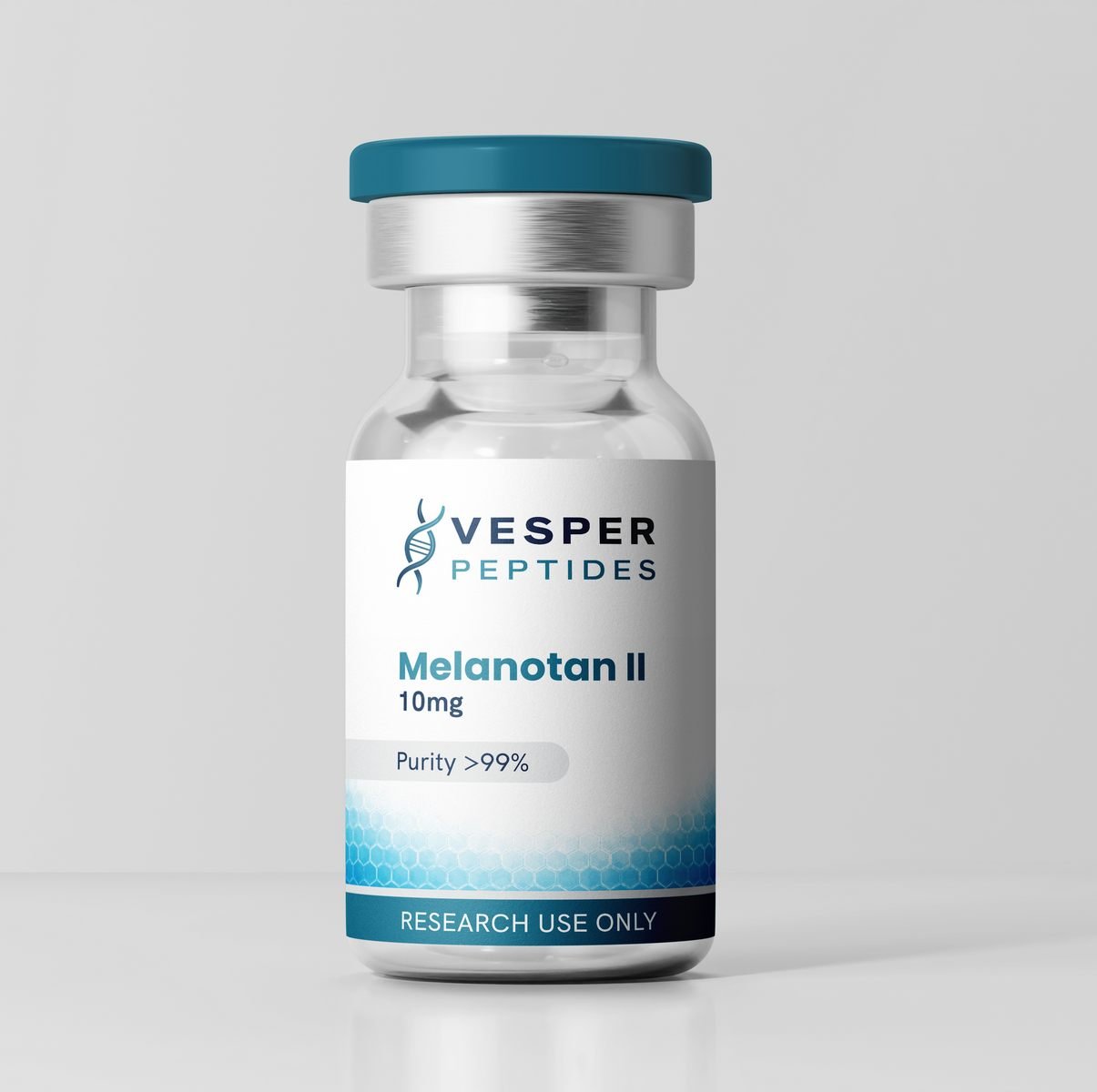
Melanotan II — Multi-Receptor Cyclic Alpha-MSH Analogue Research Peptide
Melanotan II ([Ac-Nle⁴, Asp⁵, D-Phe⁷, Lys¹⁰]-α-MSH(4-10)-NH₂) is a synthetic cyclic heptapeptide alpha-MSH analogue with an N-terminal acetyl group and a cyclic lactam bridge between positions 5 and 10. This cyclic structure enhances metabolic stability and receptor binding potency while broadening its melanocortin receptor engagement profile to include MC1R, MC3R, and MC4R. Researchers in melanocortin pharmacology, pigmentation biology, and metabolic neuroscience use this Melanotan II research peptide both as a multi-receptor melanocortin agonist tool and as the parent compound from which PT-141 (Bremelanotide) is derived. Furthermore, its broader receptor profile compared to the MC1R-selective Melanotan I makes it a critical comparator compound in receptor subtype selectivity research.
Mechanism of Action
Melanotan II activates three melanocortin receptor subtypes with distinct biological consequences at each.
At MC1R — it drives melanocyte activation, MITF upregulation, tyrosinase expression, and eumelanin synthesis through the same cAMP/PKA/CREB pathway activated by Melanotan I. Consequently, it produces pigmentation biology research data directly comparable to Melanotan I at this receptor subtype.
At MC3R — it modulates energy balance through hypothalamic and limbic melanocortin circuitry. MC3R activation contributes to energy expenditure regulation and feeding behavior modulation. As a result, researchers use Melanotan II in studies examining MC3R-specific contributions to energy homeostasis.
At MC4R — it activates hypothalamic paraventricular nucleus neurons, suppresses food intake, increases energy expenditure, and modulates autonomic nervous system tone. Furthermore, MC4R activation produces the centrally mediated arousal pathway signaling that forms the mechanistic basis of the PT-141 metabolite’s CNS activity profile.
Key Research Applications
- Multi-receptor melanocortin pharmacology — Simultaneous characterization of MC1R, MC3R, and MC4R receptor engagement, cAMP signaling profiles, and subtype-specific downstream effector activation using Melanotan II as a broad-spectrum melanocortin agonist.
- Comparative receptor selectivity research — Head-to-head experimental designs comparing Melanotan II against Melanotan I (MC1R-selective) and PT-141 (MC3R/MC4R-selective) to isolate the biological contribution of each receptor subtype.
- Melanogenesis research — Studies examining MC1R-mediated MITF activation, eumelanin synthesis, and melanin transfer in melanocyte models using Melanotan II alongside or independently of Melanotan I.
- Energy homeostasis and appetite research — Investigation of MC3R and MC4R-mediated food intake suppression, energy expenditure modulation, and hypothalamic circuit activation.
- Cyclic peptide pharmacology — Studies examining how the cyclic lactam bridge in Melanotan II affects receptor binding conformation, affinity, selectivity, and metabolic stability relative to linear α-MSH analogues.
Peptide Profile
| Parameter | Detail |
|---|---|
| Common Name | Melanotan II |
| Structure | Cyclic heptapeptide with N-terminal acetyl group |
| Receptor Targets | MC1R, MC3R, MC4R |
| PT-141 Relationship | Parent compound of PT-141 (Bremelanotide) |
| Molecular Weight | ~1,024 Da |
| Form | Lyophilized powder |
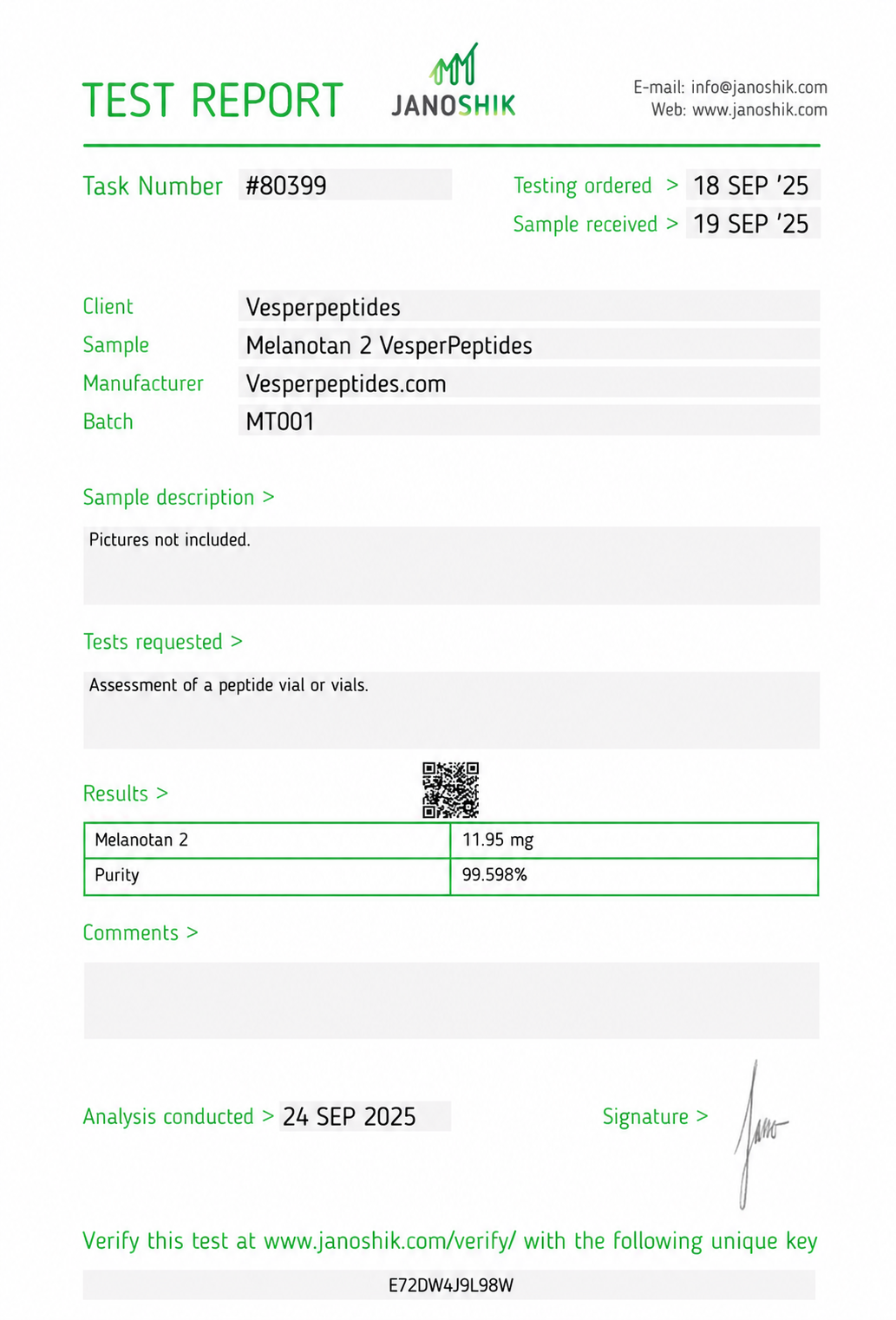
| Purity | ≥98% (HPLC verified) |
| Available Size | 10mg |
| Storage | −20°C (lyophilized); 4°C (reconstituted) |
| Reconstitution | Sterile bacteriostatic water or dilute acetic acid |
Reconstitution & Storage
Reconstitute with sterile bacteriostatic water or dilute acetic acid if needed for initial solubilization. Add solvent slowly along the vial wall and swirl gently. Store lyophilized vials at −20°C, protected from light. Once reconstituted, maintain at 4°C and use within 28 days. Avoid repeated freeze-thaw cycles.
For research use only. Not intended for human or veterinary administration.
Reviews
There are no reviews yet.