
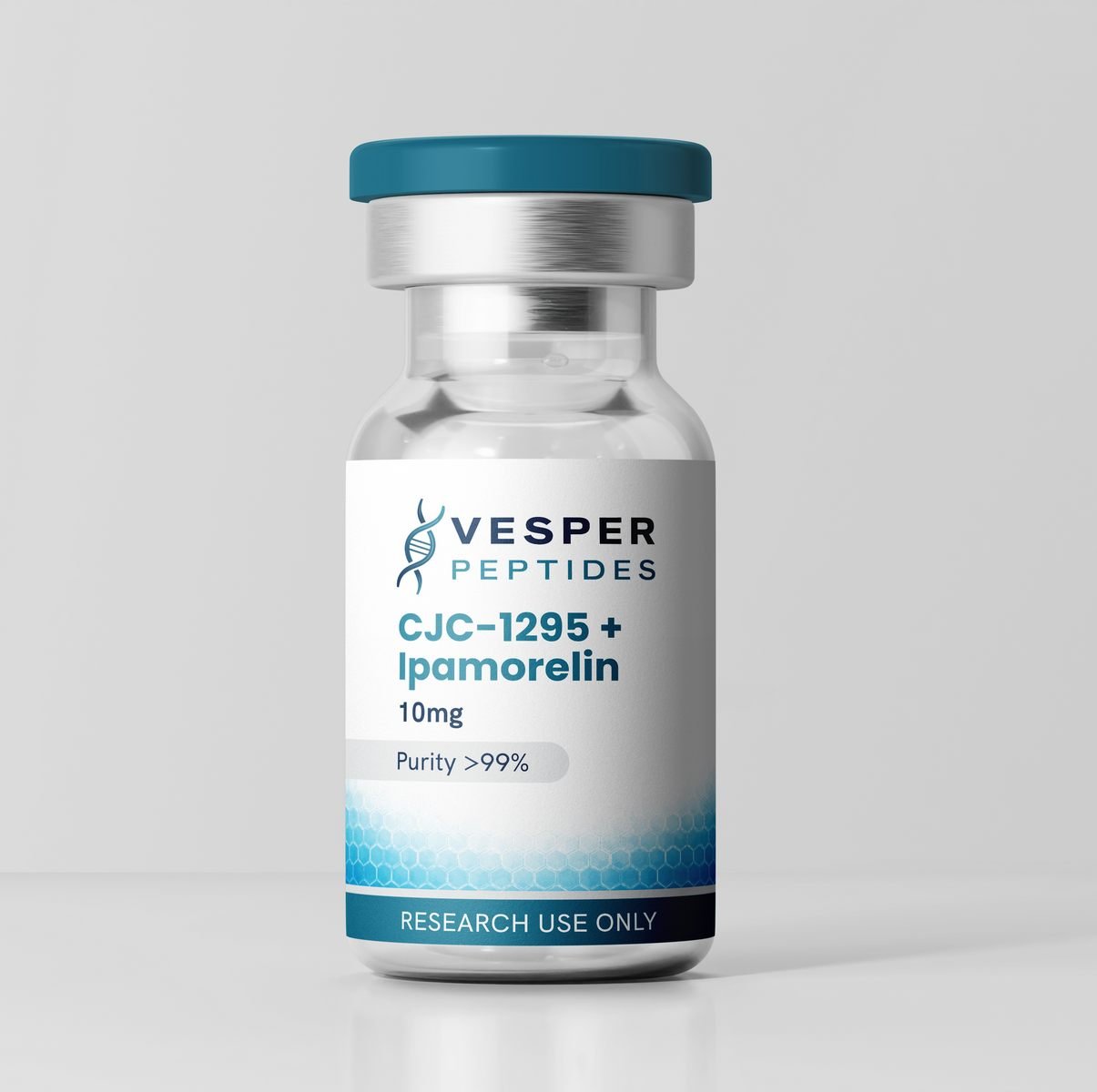
CJC-1295 + Ipamorelin — Dual GHRH and GHRP Research Peptide Blend
CJC-1295 + Ipamorelin is a research-grade combination formulation that pairs CJC-1295 (without DAC) — a stabilized GHRH analogue — with Ipamorelin — a selective pentapeptide GHRP — in a single lyophilized vial. Researchers in growth hormone biology, pituitary pharmacology, and somatotropic axis research use this CJC-1295 Ipamorelin research peptide to study the synergistic amplification of GH release that results from simultaneously activating two independent GH secretagogue receptor systems. Furthermore, consolidating both compounds into one formulation simplifies dual-secretagogue research protocols significantly, eliminating the need for separate reconstitution, independent dosing calculations, and sequential administration steps.
Mechanism of Action
This blend activates two distinct and complementary GH secretagogue receptor pathways simultaneously.
CJC-1295 (No DAC) targets the GHRH receptor (GHRHR) on anterior pituitary somatotroph cells. It activates Gs-protein coupled adenylyl cyclase signaling, elevates intracellular cAMP, and directly stimulates GH synthesis and pulsatile secretion. Its four stabilizing amino acid substitutions protect it from DPP-IV degradation and extend its active half-life beyond native GHRH. Consequently, it provides a defined, time-controlled GHRHR stimulation window within the experimental protocol.
Ipamorelin simultaneously targets the ghrelin receptor (GHSR-1a) through a completely independent mechanism. It acts as a selective GHSR-1a agonist, potentiating GH release by increasing GH pulse amplitude through a pathway that is additive and synergistic with GHRHR activation. Crucially, Ipamorelin demonstrates high receptor selectivity — at GH-stimulating doses, it produces minimal stimulation of cortisol, ACTH, or prolactin secretion. Therefore, researchers specifically value it as a clean GHRP comparator compound that does not confound experimental results with HPA axis activation.
As a result of dual-receptor co-activation, the combination produces GH pulse amplitudes that exceed those achievable by either compound alone. This synergistic GH release profile makes the blend a uniquely powerful tool for studying the upper range of physiologically relevant GH secretory responses.
Why Researchers Use the Combination Over Individual Compounds
CJC-1295 alone stimulates GH release through GHRHR activation effectively. However, it does not engage GHSR-1a. Ipamorelin alone activates GHSR-1a but does not engage GHRHR. Consequently, neither compound alone replicates the synergistic dual-receptor GH amplification that the combination produces.
Furthermore, managing two separate vials — each requiring independent reconstitution, separate dosing volume calculations, and sequential administration — introduces practical variability into dual-secretagogue experimental protocols. This pre-formulated CJC-1295 Ipamorelin blend eliminates all of these challenges in a single preparation step. Additionally, using a single vial batch across an entire study eliminates inter-lot compound variability between the two components.
Key Research Applications
Researchers actively use this blend across multiple GH research domains. Specifically, it supports:
- Synergistic GH secretagogue research — Characterization of the additive and synergistic GH release produced by simultaneous GHRHR and GHSR-1a co-activation compared to mono-receptor stimulation in pituitary cell culture and ex vivo models.
- GH pulse amplitude studies — Investigation of how dual-receptor co-activation modifies GH pulse amplitude, duration, and total GH secretory output relative to single-compound controls.
- Selective GHRP pharmacology — Studies exploiting Ipamorelin’s high GHSR-1a selectivity to characterize ghrelin receptor-mediated GH release in isolation from cortisol, ACTH, and prolactin confounders.
- Pituitary somatotroph biology — Research examining somatotroph responses to combined GHRHR and GHSR-1a stimulation, including intracellular signaling crosstalk, GH granule exocytosis dynamics, and receptor co-expression studies.
- IGF-1 axis downstream research — Studies examining the downstream hepatic IGF-1 production and circulating IGF-1 levels resulting from synergistically amplified GH secretion.
- Comparative dual secretagogue research — Experimental designs benchmarking CJC-1295 + Ipamorelin against other GHRH/GHRP pairings — such as CJC-1295 + GHRP-6 or Sermorelin + Hexarelin — to characterize the selectivity and synergy profiles of different dual-secretagogue combinations.
Peptide Profile
| Parameter | Detail |
|---|---|
| Components | CJC-1295 (No DAC) + Ipamorelin |
| Receptor Targets | GHRHR (CJC-1295) + GHSR-1a (Ipamorelin) |
| Mechanism Class | Dual GHRH analogue / selective GHRP blend |
| Ipamorelin Selectivity | Minimal cortisol, ACTH & prolactin stimulation |
| Form | Lyophilized powder (co-formulated) |
| Purity | ≥98% per component (HPLC verified) |
| Available Size | 10mg |
| Storage | −20°C (lyophilized); 4°C (reconstituted) |
| Reconstitution | Sterile bacteriostatic water |
Reconstitution Guidelines
Reconstitute with sterile bacteriostatic water. Add solvent slowly along the inner vial wall and gently swirl until the lyophilized powder fully dissolves. Do not shake or vortex. For the 10mg combination vial, researchers typically add 1–2ml of solvent to achieve a suitable working concentration for most pituitary and GH assay systems. Furthermore, prepare single-use aliquots before storage at 4°C to minimize repeated freeze-thaw exposure across multi-session experimental protocols.
Storage Conditions
Store lyophilized vials at −20°C, protected from direct light and moisture. Keep vials sealed until the point of reconstitution. Furthermore, once reconstituted, maintain at 4°C and use within 28–30 days. Avoid repeated freeze-thaw cycles to preserve the receptor binding activity of both peptide components throughout the experimental program.
For research use only. Not intended for human or veterinary administration. This product is not a drug, supplement, or food product.
Reviews
There are no reviews yet.