
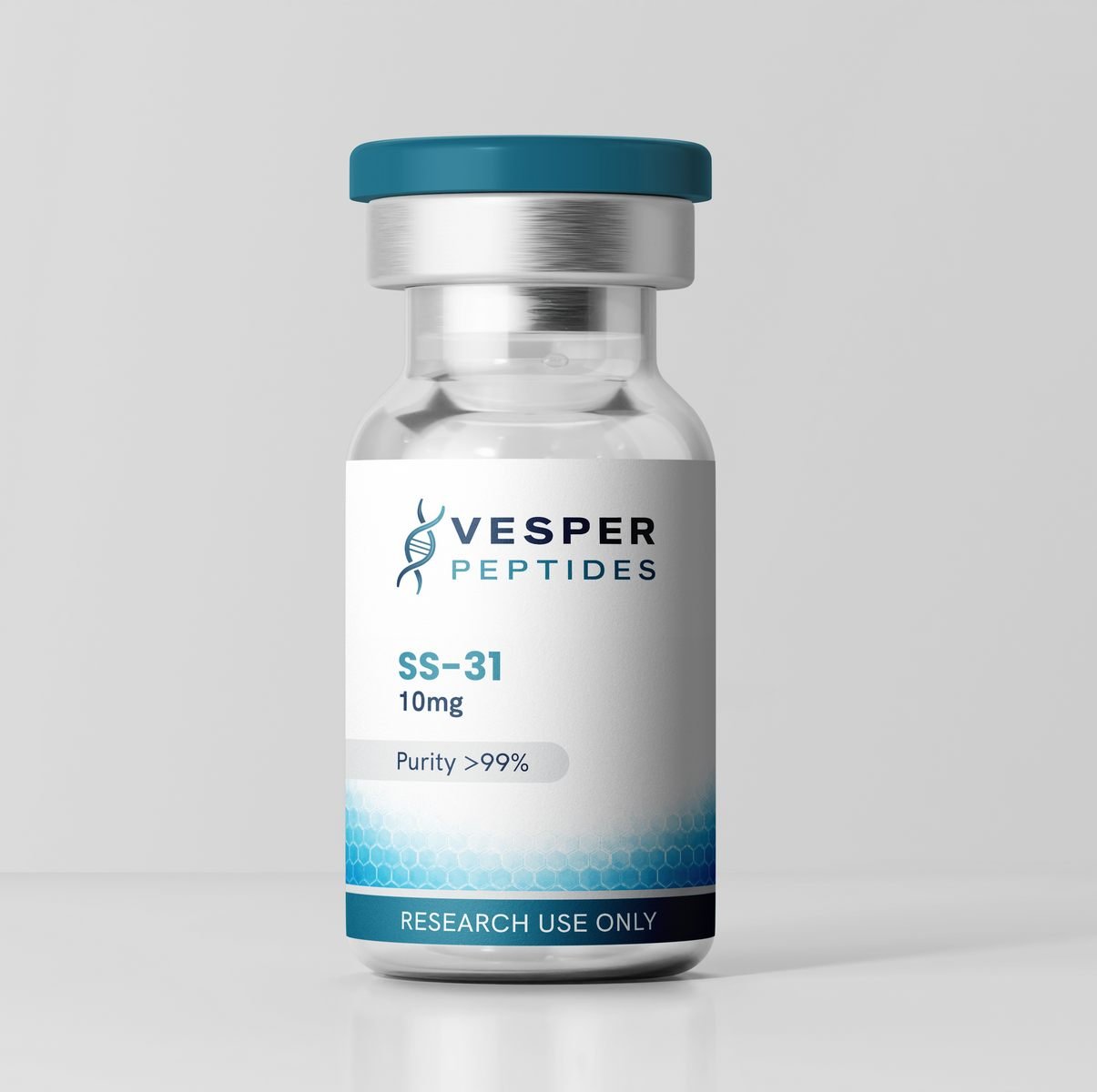
SS-31 (Elamipretide) — Mitochondria-Targeted Cardiolipin Research Peptide
SS-31 (D-Arg-2′6′-Dmt-Lys-Phe-NH₂), also known as Elamipretide or MTP-131, is a synthetic cell-permeable tetrapeptide that incorporates alternating cationic and aromatic residues — a structural motif that drives selective partitioning to the inner mitochondrial membrane (IMM). Researchers in mitochondrial biology, cardiovascular research, and aging science use this SS-31 research peptide to study cardiolipin interaction, mitochondrial cristae architecture, electron transport chain (ETC) function, and protection against mitochondrial permeability transition pore (mPTP) opening in diverse experimental systems. Furthermore, SS-31’s unique ability to reach and stabilize the IMM — without disrupting mitochondrial membrane potential — makes it a uniquely precise and non-toxic mitochondrial research tool.
Mechanism of Action
Cardiolipin interaction — SS-31 selectively interacts with cardiolipin — an anionic phospholipid almost exclusively localized to the IMM. This interaction stabilizes cardiolipin-cytochrome c supercomplexes, preserving the structural integrity of electron transport chain superassemblies. As a result, it maintains efficient electron transfer between respiratory chain complexes and reduces electron leak and reactive oxygen species (ROS) generation.
Cristae architecture preservation — SS-31 stabilizes the curvature of inner mitochondrial membrane cristae. This cristae architecture maintenance preserves the spatial organization of ETC complexes and ATP synthase oligomers — a structural requirement for efficient oxidative phosphorylation. Consequently, SS-31-treated mitochondria maintain higher ATP production rates under stress conditions than untreated controls.
mPTP inhibition — SS-31 reduces the probability of mitochondrial permeability transition pore opening under oxidative and ischemic stress conditions. Furthermore, mPTP inhibition prevents mitochondrial swelling, cytochrome c release, and downstream caspase activation. Therefore, researchers studying ischemia-reperfusion injury and apoptotic signaling specifically use SS-31 as a mitochondrial protection reference compound.
Key Research Applications
- Cardiolipin biology research — Studies examining SS-31 interaction with cardiolipin, cardiolipin-cytochrome c complex stabilization, and the role of cardiolipin organization in ETC supercomplex assembly.
- Ischemia-reperfusion research — Preclinical models examining SS-31 cardioprotective and neuroprotective effects in ischemia-reperfusion injury through mPTP inhibition and ROS attenuation.
- Heart failure research — Studies investigating SS-31 effects on mitochondrial function restoration, cardiac energy metabolism, and ventricular function in heart failure preclinical models.
- Neurodegeneration research — Investigation of SS-31 neuroprotective effects in Parkinson’s disease, Alzheimer’s disease, and ALS mitochondrial dysfunction models.
- Aging mitochondrial research — Studies examining SS-31 effects on age-associated mitochondrial dysfunction, ETC complex activity decline, and oxidative damage accumulation in aged cell and tissue systems.
Peptide Profile
| Parameter | Detail |
|---|---|
| Common Name | SS-31 / Elamipretide / MTP-131 |
| Sequence | D-Arg-2′6′-Dmt-Lys-Phe-NH₂ |
| Target | Cardiolipin / Inner mitochondrial membrane |
| Cell Permeable | Yes |
| Molecular Weight | ~640 Da |
| Form | Lyophilized powder |
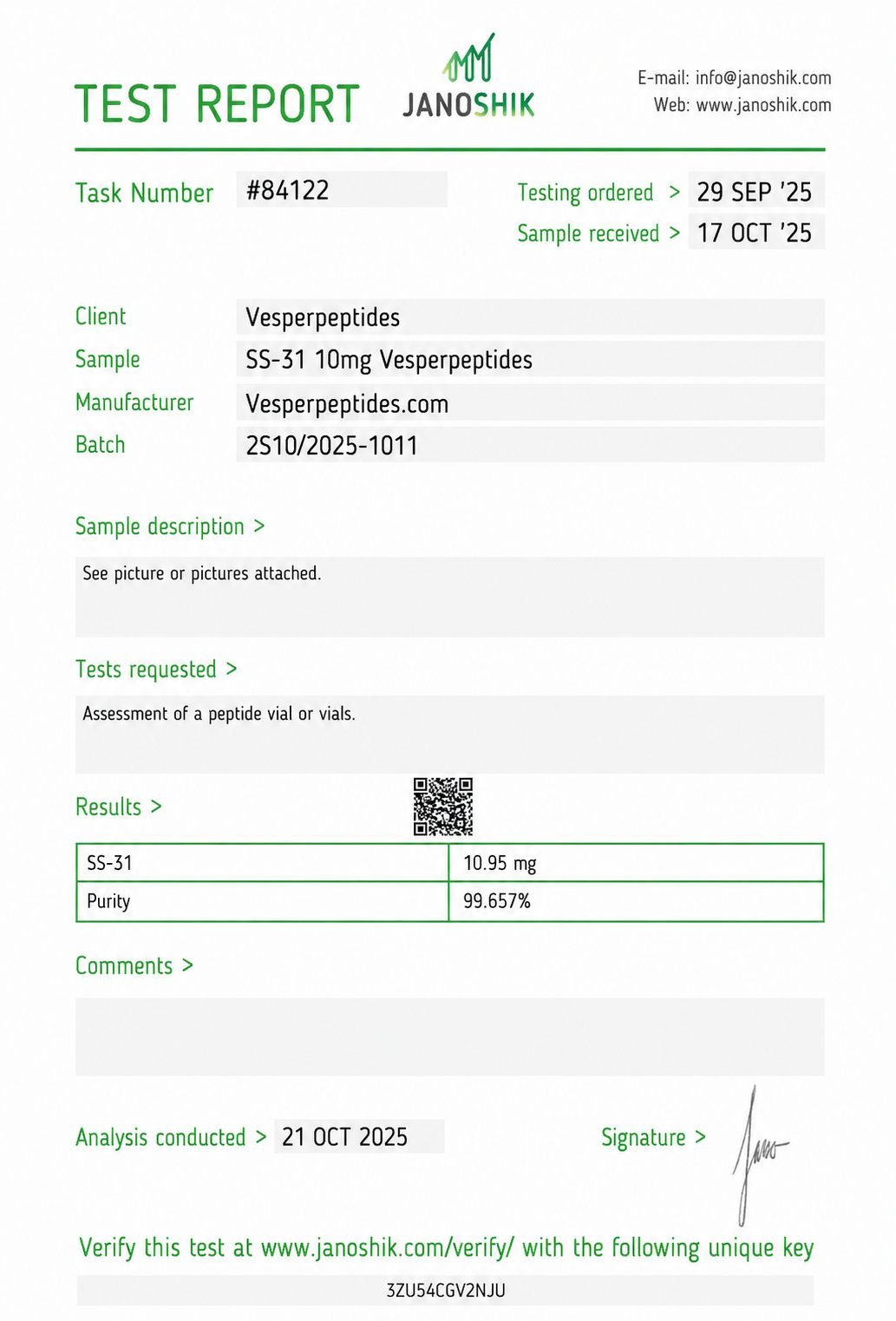
| Purity | ≥98% (HPLC verified) |
| Available Size | 10mg |
| Storage | −20°C (lyophilized); 4°C (reconstituted) |
| Reconstitution | Sterile water or PBS |
| Solubility | Freely water-soluble |
Reconstitution & Storage
Reconstitute with sterile water or PBS. SS-31 is freely water-soluble and dissolves readily. Add solvent slowly along the vial wall and swirl gently. Store lyophilized vials at −20°C, protected from light. Once reconstituted, maintain at 4°C and use within 28 days. Avoid repeated freeze-thaw cycles.
For research use only. Not intended for human or veterinary administration.


Reviews
There are no reviews yet.