
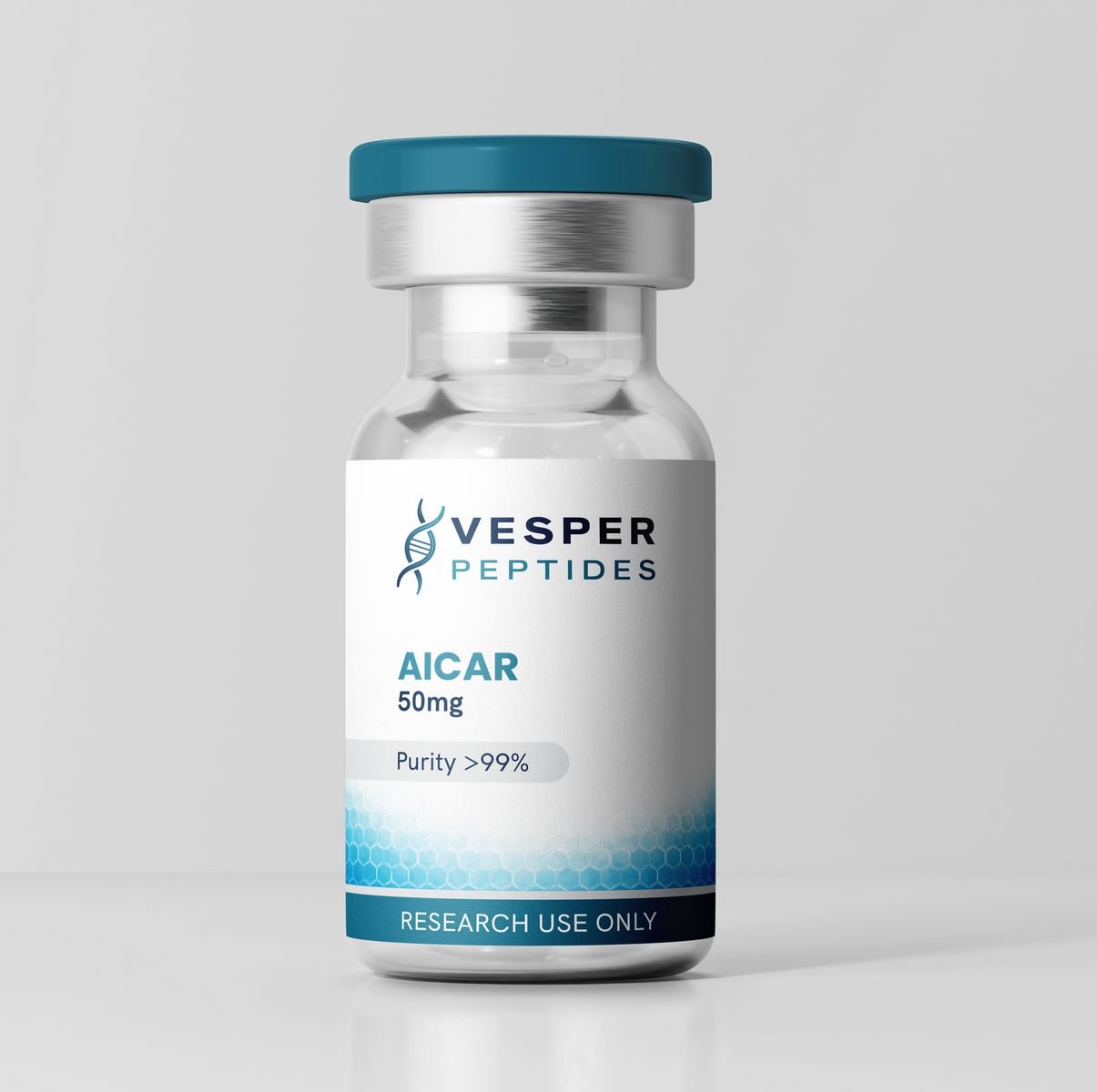
AICAR — Cell-Permeable AMPK Activator Research Compound
AICAR (5-Aminoimidazole-4-carboxamide-1-β-D-ribofuranoside) is a nucleoside analogue and well-characterized AMPK activator that researchers across metabolic biology, exercise physiology, and pharmacology use extensively as a primary tool compound. Inside cells, AICAR undergoes phosphorylation by adenosine kinase to form AICA ribonucleotide (ZMP) — a structural AMP mimetic that directly activates AMP-activated protein kinase (AMPK) by mimicking the cellular energy-depleted state. Consequently, it triggers a broad downstream metabolic response that closely parallels the cellular adaptations to energy stress. Furthermore, this AICAR research compound offers a pharmacological approach to AMPK activation that is reproducible, dose-dependent, and well-documented across thousands of published studies.
Mechanism of Action
AICAR enters cells through adenosine transporters and undergoes rapid phosphorylation to ZMP by adenosine kinase. ZMP accumulates intracellularly and binds to the γ-subunit of AMPK, mimicking the allosteric effect of AMP. As a result, it activates AMPK without actually depleting cellular ATP — a critical advantage over other energy-stress mimetics that compromise cell viability.
AMPK activation by AICAR then drives a coordinated metabolic response. It phosphorylates acetyl-CoA carboxylase (ACC), reducing malonyl-CoA levels and thereby relieving the inhibition of carnitine palmitoyltransferase-1 (CPT-1). This directly accelerates mitochondrial fatty acid import and β-oxidation. Additionally, AMPK activates GLUT4 translocation to the plasma membrane, enhancing glucose uptake independently of insulin signaling. Furthermore, AMPK phosphorylates PGC-1α, a master regulator of mitochondrial biogenesis, driving the expression of genes encoding mitochondrial proteins and expanding mitochondrial network density.
Therefore, researchers use this AMPK activator research compound to simultaneously investigate multiple nodes of the energy sensing network in a single experimental system.
Key Research Applications
Researchers actively use AICAR across a broad range of metabolic and cellular research domains. Specifically, it supports:
- AMPK signaling research — Characterization of AMPK activation kinetics, substrate phosphorylation profiles, and isoform-specific signaling responses in diverse cell types including myocytes, hepatocytes, and adipocytes.
- Glucose uptake studies — Investigation of AMPK-driven GLUT4 translocation and insulin-independent glucose transport in skeletal muscle cell models and primary myotube systems.
- Mitochondrial biogenesis research — Studies examining PGC-1α activation, mitochondrial DNA replication, and mitochondrial network expansion in response to sustained AMPK activation.
- Fatty acid oxidation research — Investigation of CPT-1 disinhibition, β-oxidation flux, and lipid utilization dynamics in hepatocyte and myocyte experimental models.
- Metabolic disease models — Use of AICAR as a pharmacological tool to study AMPK pathway dysfunction in insulin resistance, non-alcoholic fatty liver disease (NAFLD), and type 2 diabetes preclinical models.
- Exercise biology research — Studies modelling the molecular adaptations of exercise at the cellular level — particularly in skeletal muscle — using AICAR as a contractile activity mimetic.
- Cancer metabolism research — Investigation of AMPK-mediated mTORC1 suppression, autophagy induction, and metabolic reprogramming in transformed cell lines and tumour models.
Why AICAR Remains a Gold-Standard AMPK Tool Compound
Several pharmacological AMPK activators exist in the research toolkit. However, AICAR occupies a unique position as an indirect, physiologically relevant AMPK activator. Unlike direct allosteric AMPK activators such as A-769662, AICAR activates AMPK through an AMP-mimetic mechanism that closely recapitulates endogenous energy-stress signaling. Consequently, researchers use it as a reference standard in AMPK biology and as a benchmark against which newer activators are frequently compared. Furthermore, its broad compatibility with mammalian cell culture systems and its extensive validation across decades of published literature make it one of the most trusted metabolic research compounds available.
Compound Profile
| Parameter | Detail |
|---|---|
| Common Name | AICAR |
| Full Name | 5-Aminoimidazole-4-carboxamide ribonucleotide |
| Also Known As | Acadesine, AICA Riboside |
| Primary Target | AMPK (via ZMP accumulation) |
| Mechanism Class | Indirect AMPK activator / AMP mimetic |
| Molecular Weight | 338.21 Da |
| Form | Lyophilized powder |
| Purity | ≥98% (HPLC verified) |
| Available Size | 50mg |
| Storage | −20°C (lyophilized); 4°C (reconstituted) |
| Reconstitution | Sterile water or PBS |
| Solubility | Freely water-soluble |
Reconstitution Guidelines
Reconstitute AICAR with sterile water or phosphate-buffered saline (PBS). It dissolves readily in aqueous solution without requiring organic solvents or acidic conditions. For a 50mg vial, researchers typically prepare a stock solution of 10–50mM depending on the assay system requirements. Additionally, AICAR stock solutions store stably at −20°C for extended periods. However, researchers should avoid repeated freeze-thaw cycles to preserve compound integrity across long experimental series.
Storage Conditions
Store lyophilized AICAR at −20°C, protected from light and moisture. Furthermore, keep vials sealed until the point of reconstitution. Once reconstituted, store at −20°C for long-term stock storage or at 4°C for working solutions used within 1–2 weeks. The 50mg format provides researchers with sufficient material for extended experimental programs without frequent reordering.
For research use only. Not intended for human or veterinary administration. This product is not a drug, supplement, or food product.
Reviews
There are no reviews yet.